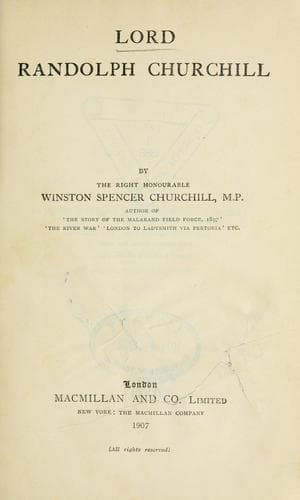
Churchill, Randolph Henry Spencer, Lord, 1849-1895
This occasion was provided on October 30, and led to a singularly
unpleasant debate. Lord Randolph Churchill quoted numerous extracts from
Mr. Chamberlain’s speeches. He asserted that no Minister of the Crown
had ever used such language and that Irish members had been committed to
prison for language much less strong. He declared that Mr. Chamberlain
knew beforehand of the counter-demonstration and of what it was intended
to effect and that he might easily have prevented the riot had he chosen
to do so. Mr. Chamberlain exerted himself greatly, and not
unsuccessfully, in replying. He in his turn was able to discover in Lord
Randolph Churchill’s speeches some traces of violent language. He flatly
denied that he had had any personal complicity in the riot, which, he
explained, had arisen solely from the mismanagement of the Tory
organisation and from their attempt to give their meeting the character
of a national demonstration. But the most effective part of his speech
consisted in a number of affidavits of roughs, said to have been engaged
by the Secretary of the Conservative Association to turn out Liberals
from the meeting, whose violence it was alleged had provoked the
outbreak. When he sat down he had in great measure stemmed the tide
which had been running strongly against him. As his speech was drawing
to a close Lord Randolph leaned across the gangway and asked Sir Michael
Hicks-Beach if he would reply. Sir Michael, much impressed by Mr.
Chamberlain’s argument, declined; but Sir Hardinge Giffard, to whom Lord
Randolph then turned, stepped into the breach, and with little
premeditation made a most admirable and effective rejoinder, which
swayed the opinion of the House and threw the gravest doubt upon the
authenticity and credibility of the documents from which Mr. Chamberlain
had quoted. Upon the division Lord Randolph’s amendment was defeated by
214 to 178. ‘The majority,’ observes the _Annual Register_, ‘exonerating
Mr. Chamberlain from any blameworthy act, was far smaller than a member
of the Cabinet commanding the confidence and sympathy of his supporters
had a right to expect.’
Public-domain text, read in full here on John Shaqi.
Reviews
Reviews
No reviews yet
Be the first to share your thoughts on this work.
Elsewhere in the archive
Join the Discussion
Join the discussion
Sign in to leave a comment or review.
Sign InorCreate an account