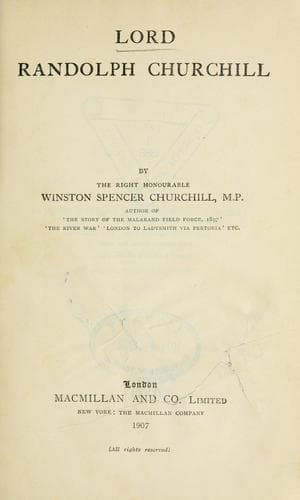
Churchill, Randolph Henry Spencer, Lord, 1849-1895
The dispute was then carried by both parties into the Courts. The
summonses and counter-summonses were heard together at Birmingham on
successive days during the month of November, and when Mr. Chamberlain
was examined as a witness (November 26) attempts were made to fix upon
him the responsibility of suggesting that the affidavits should be
procured. But he denied it. On December 6, the compromise upon the
Franchise and Redistribution Bill having been achieved nearly three
weeks before, the proceedings came to an abrupt close. But at the
Assizes (February 28 and March 2, 1885) a man named Peter Joyce, said to
be ‘Larry Mack,’ a notorious rough whose affidavit had been quoted in
Parliament, was tried before Mr. Justice Field on the charge of criminal
libel and sentenced, despite the lukewarmness of the prosecution and
strong recommendation to mercy, to six weeks’ imprisonment. A Liberal of
respectable antecedents was found guilty of having had the ‘forged
tickets’ printed and was heavily fined. No evidence was ever produced to
sustain any charge against Mr. Chamberlain of having himself fomented
the disorders; but an impression was created that the whole
affair--especially the discharging of the fireworks upside down--showed
that he had been only partially successful in exerting those influences
of moral restraint which are so much to be commended in political
leaders during times of popular excitement.
The Aston riots led to some curious consequences. When Lord Randolph was
arranging for the prosecutions of the ‘roughs’ whose depositions Mr.
Chamberlain had read to the House of Commons, he asked one of his
friends to find him a lawyer of repute who would conduct the case so as
to make ‘as much political capital out of it as possible.’ A Mr. Henry
Matthews--already a barrister of distinction upon the Midland
Circuit--was recommended to him. They met at dinner on two successive
nights. Lord Randolph was perfectly delighted with his conversation and
his personality and formed the very highest opinion of his powers. At
his insistence Mr. Matthews became a candidate for a Birmingham seat.
Eighteen months later, when he was reading in the Athenæum Club the
newspaper rumours of the composition of Lord Salisbury’s second
Administration, he was startled and astonished by Lord Randolph breaking
in upon him with the offer of the office of Home Secretary.
The course of their violent political quarrels and the harsh language
and personal charges with which they were accompanied produced a total
breach in Lord Randolph’s private friendship with Mr. Chamberlain. They
no longer addressed or saluted each other and such correspondence as was
necessary was conducted on both sides with frigid formality. Thus:--
House of Commons: October 28.
Public-domain text, read in full here on John Shaqi.
Reviews
Reviews
No reviews yet
Be the first to share your thoughts on this work.
Elsewhere in the archive
Join the Discussion
Join the discussion
Sign in to leave a comment or review.
Sign InorCreate an account