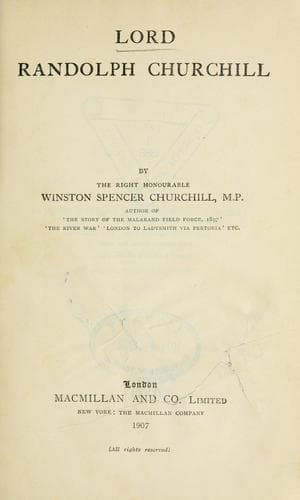
Churchill, Randolph Henry Spencer, Lord, 1849-1895
One more incident which arose out of the Reform Bill must be noticed in
its place. When Parliament assembled for the winter session the
Conservative leaders agreed with Lord Randolph Churchill to offer a
regular though perfunctory resistance to the second passage of the
Reform Bill through the House of Commons, in order to strengthen the
position of the House of Lords in effecting the compromise which was now
recognised as inevitable. Lord Randolph accordingly placed on the paper
an amendment to the second reading, setting forth ‘that any measure
purporting to provide for the better representation of the people must
be accompanied by provisions for the proper arrangement of electoral
areas.’ This seemed to repeat as a general principle the amendment which
Colonel Stanley had moved as a precise instruction on May 23, when the
Bill was for the first time in Committee, which amendment Lord Randolph
and the Fourth Party had opposed and indeed denounced. The political
situation was entirely changed; but the verbal similarity did not escape
one acute, retentive mind.
In Lord Randolph’s absence at the funeral of Lord Londonderry his
amendment was moved by Mr. Stanhope. To the surprise of his party Mr.
Gorst rose from below the gangway and thereupon criticised and opposed
the amendment in terms which bore a sufficiently close resemblance to
those in which Lord Randolph had opposed it when it had last been moved.
By this very able and perfectly consistent speech Mr. Gorst gave great
offence to all sections of the Conservative party, who were now united
in an embrace of unaffected love. Lord Randolph, when he read the
newspapers next day, accepted it as a personal declaration of war. He
was very angry. ‘Gorst,’ he said, ‘must be punished’; and accordingly on
the next sitting of the House (November 7) he administered to his
mutinous lieutenant a castigation prolonged, deliberate, and severe. ‘I
have yet to learn,’ he observed, with undisturbed gravity, ‘that either
the traditions of party warfare or Parliamentary etiquette teaches one
to desert one’s party and stand aloof from it and refrain from giving
assistance to it, simply because of the very inadequate and miserable
reason that in one’s own poor and very feeble judgment one does not
altogether approve of the course which may have led them into that
difficulty.’ The mirth which this grimace excited was strengthened by
the joy and relief alike of Government and Opposition at the breaking-up
of the formidable confederacy at whose hands they had endured so much.
Public-domain text, read in full here on John Shaqi.
Reviews
Reviews
No reviews yet
Be the first to share your thoughts on this work.
Elsewhere in the archive
Join the Discussion
Join the discussion
Sign in to leave a comment or review.
Sign InorCreate an account