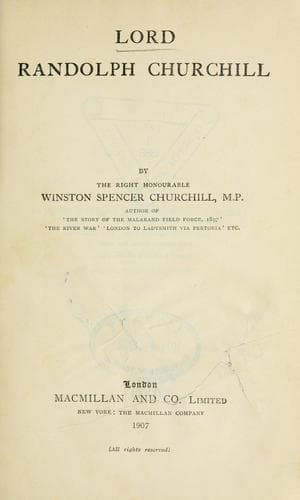
Churchill, Randolph Henry Spencer, Lord, 1849-1895
On December 3 Lord Randolph sailed in the _Rohilla_ for India. Since the
beginning of history many travellers have visited the East. Few have
neglected to record their adventures. But if the reader is inclined to
follow the subject of this story into an atmosphere remote from that of
Westminster his own letters will be found to supply an easy and
connected narrative.[27] After several years of strife he entered upon a
brief interval of peace. The battles of the Reform Bill had ended in a
compromise far less unsatisfactory to Tory interests than could have
been expected. The agitation which menaced the House of Lords was at an
end. His dispute with Lord Salisbury was settled. The Conservative party
had acclaimed the return of the prodigal son. The Aston riots were
forgotten in his renewed friendship with Mr. Chamberlain. And as the
English coast-line faded, a passing temper of tranquil benevolence led
him to send through Wolff messages of amity to all his friends--‘even to
the erring Gorst.’
CHAPTER IX
THE FALL OF THE GOVERNMENT
‘Of this, however, I am well persuaded, that it is better to be
impetuous than cautious. For Fortune is a woman who to be kept
under must be beaten and roughly handled; and we see that she
suffers herself to be more readily mastered by those who treat her
so, than by those who are more timid in their approaches. And
always, like a woman, she favours the young, because they are less
scrupulous and fiercer, and command her with greater
audacity.’--MACHIAVELLI: _The Prince_, chapter XXV.
[Sidenote: 1885 ÆT. 36]
This account, which has hitherto been concerned with the doings of Lord
Randolph Churchill and the steps by which he attained power in his party
and in Parliament, must now for a time be greatly extended. However
strictly the thread of personal narrative be followed, biography
broadens insensibly into history, and the career of a private member
becomes a recognisable part of the fortunes of the nation. We enter upon
a period of tumult and change. Within little more than a year two
General Elections were fought and four separate Administrations took
their seats on the Treasury Bench. In order to find an equal convulsion
it is necessary to go back almost exactly a hundred years, to the time
between the fall of Lord North’s Administration in 1782 and the final
triumph of Mr. Pitt after his dissolution in 1784. In each period
Ministries were constructed and fell like houses of cards; in each a
new, young figure sprang suddenly into universal attention; in each, one
of the historic parties in the State entered into a disastrous
coalition; and the other, after taking office in a minority, secured a
predominance which lasted for a generation.
Public-domain text, read in full here on John Shaqi.
Reviews
Reviews
No reviews yet
Be the first to share your thoughts on this work.
Elsewhere in the archive
Join the Discussion
Join the discussion
Sign in to leave a comment or review.
Sign InorCreate an account