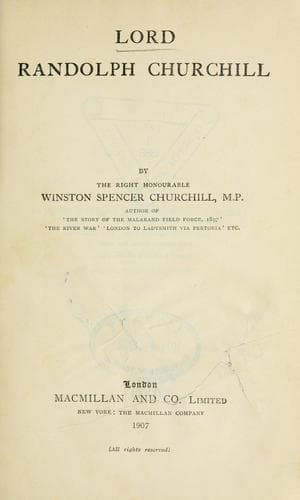
Churchill, Randolph Henry Spencer, Lord, 1849-1895
The Administration of 1880 tottered to its fall in tragedy and disaster.
General Gordon perished and Khartoum fell in February. The expeditionary
columns recoiled in sorrow and failure from the desert and the Nile. The
Queen telegraphed her displeasure openly to the Prime Minister; and on a
vote of censure the Government escaped only by a majority of fourteen
(February 27). Few more critical divisions have been taken in modern
times; for the defection of eight more discontented Whigs or Liberals
would have procured a dissolution before either the Reform or
Redistribution Act could have come into operation. In the temper of the
moment, upon the votes of the old electorate, the Conservative party
could hardly have failed to gain a clear majority. With such a prize in
view the attacks of the Opposition increased in vehemence, bitterness,
and effect. Votes of censure succeeded each other with almost
bewildering rapidity. Early in the year Mr. Chamberlain began to
proclaim the new demands of Radicalism in a series of crudely impressive
speeches. Nationalist Ireland struggled in the grip of Dublin Castle.
The menace of Russian aggression towards the Indian frontier grew into
reality. Dynamite explosions tore up the Treasury Bench and shook the
structure of Westminster Hall. A momentous General Election drew near.
It was indeed, as Mr. Gladstone noted in his diary, ‘a time of _Sturm
und Drang_.’
Lord Randolph Churchill returned from India in March, to find himself in
a position of unusual importance. He had won no battle, negotiated no
peace; he had passed no great measure of reform; he had never held
public office; he was not even a Privy Councillor; yet he was welcomed
on all sides with interest or acclamation. The political temperature was
steadily rising with the approach of the General Election. The Fourth
Party received him with joy and the House of Commons with satisfaction.
Mr. Gladstone in his courtly way walked across the House to shake hands
with him. His absence had been felt on his own side. He was looked to as
a man who would infuse a belligerent energy into the Opposition and
range their lines for the impending battle. It was evident to all men
that he occupied a position in which he might turn the balance of many
great things. ‘What place will you give him when the Government is
formed?’ Sir Stafford Northcote was asked by a friend. ‘Say rather,’
replied the leader of the Opposition, ‘what place will he give me?’ ‘I
had no idea,’ said Lord Randolph calmly when this was repeated to him,
‘that he had so much wit.’
Public-domain text, read in full here on John Shaqi.
Reviews
Reviews
No reviews yet
Be the first to share your thoughts on this work.
Elsewhere in the archive
Join the Discussion
Join the discussion
Sign in to leave a comment or review.
Sign InorCreate an account