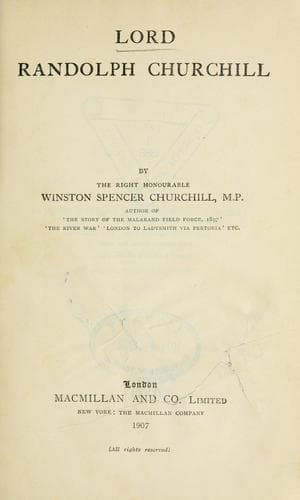
Churchill, Randolph Henry Spencer, Lord, 1849-1895
I pray you not to allow yourself to imagine that either then or now
was I or am I actuated by much, or indeed any, personal ambition.
My only desire is to see the game properly and scientifically
played, and the Conservative party fairly strong in the next
Parliament; and I do not care a rap who carries off the laurels or
the credit. The plan I propose for efficient Parliamentary action
during the remainder of the Session may be skilfully carried out
without any formal communication to Sir S. N. But not only does it
depend upon Sir Michael being supported by a certain number of
M.P.’s; that body will have to be inspired by yourself and will
have to show that in their action they are receiving and deserving
your support and approval.
I am ashamed of myself for worrying you with this interminable MS.
It is only the critical condition of our party prospects which
enables me to do it.
Yours very sincerely,
RANDOLPH S. CHURCHILL.
‘I concur very much,’ wrote Lord Salisbury in answer to this lengthy
appeal, ‘in your estimate of the evil; and your idea of surrounding the
Sultan with a body of Janissaries under Sir M. Beach is likely to be
very effective if vigorously carried out. I will gladly do anything I
can to help, but always with one reservation. I am bound to Sir S.
N.--as a colleague--by a tie, not of expediency, but of honour; and I
could not take part in anything which would be at variance with entire
loyalty to him. But what you propose will rather take the form of
assistance than supersession. I think that, properly managed, your
_jeune garde_ may do great things and acquire considerable practical
authority. I will talk the matter over with Beach whenever I can see
him. But he must abandon agriculture.’
The Conservative party had repented of their enthusiasm by May 4, when
the Committee stage of the vote of credit was again set down for
discussion. The decision to abandon the Soudan altogether and admit
defeat in that quarter of the world had soaked in. They now learned,
besides, that--vote of 11,000,000_l._ notwithstanding--Anglo-Russian
differences were to be submitted to arbitration--‘surrender disguised as
arbitration,’ as Lord Randolph Churchill called it. They were indignant
at what they considered a betrayal. But how to show their displeasure?
Sir Michael Hicks-Beach protested against the vote of credit being
proceeded with in the altered circumstances without further delay. Lord
Randolph, who had a speech all ready, intimated meekly that, unless the
vote of credit was forthwith debated, he would obstruct the passage of
Supply. The Government, anxious to get their business through, and
uncertain which section in the Opposition would prove the more
recalcitrant, proposed a compromise. Lord Randolph waved it aside and
remained obdurate. The vote of credit came on at once.
Public-domain text, read in full here on John Shaqi.
Reviews
Reviews
No reviews yet
Be the first to share your thoughts on this work.
Elsewhere in the archive
Join the Discussion
Join the discussion
Sign in to leave a comment or review.
Sign InorCreate an account