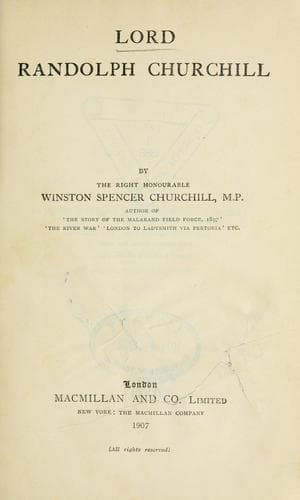
Churchill, Randolph Henry Spencer, Lord, 1849-1895
But the fate of the Government was not to be settled by anything arising
out of the stormy events in the East. Another cause, nearer home and
more intimately affecting party politics, was to operate decisively. The
Crimes Act was to expire in August. Lord Spencer insisted upon its
renewal and his demand was backed by most of the Whig Ministers. The
Radical representatives, however, refused to associate themselves with
such legislation and moderate Liberals were scarcely less reluctant to
tar their hands with Coercion before presenting themselves to the
electors as the champions of liberty. On May 15 Mr. Gladstone gave
notice that the Government would propose what was, at any rate, a
partial continuation of the measure. Five days later Lord Randolph
Churchill, at the St. Stephen’s Club, struck what was, according to Mr.
Morley, a mortal blow. He intimated that a Conservative Government would
not think it necessary to renew the Act. His language was guarded and
carefully chosen. He had to carry his audience with him and he knew with
what satisfaction many of his colleagues in the House of Commons would
repudiate his words if they thought their repudiation would be
effective. He said, in short, that he was shocked that so grave an
announcement as the renewal of a Coercion Bill should be taken as a
matter of course. The state of Ireland must be much worse than was
commonly supposed for the Radical members of the Cabinet to assent to
such a proposal. What a comment it was on Liberal administration, and on
the boasted Viceroyalty of Lord Spencer, that the Liberal party could
not govern Ireland without that arbitrary force ‘which all their
greatest orators have over and over again declared is no remedy for
lawlessness!’ ‘I believe most firmly,’ he concluded, ‘that this ought to
be the attitude of the Tory party--that while they are ready and willing
to grant to any Government of the Queen whatever powers may be
necessary, on evidence adduced, for the preservation of law and order,
they ought to be anxious and careful beyond measure not to be committed
to any act or policy which should unnecessarily wound and injure the
feelings and the sentiments of our brothers on the other side of the
Channel of St. George.’ That was all, but it was enough. The speaker was
not disavowed. The Tory party remained mute. The words were observed
and weighed both by the Irish Nationalists and the English Radicals.
Within a few days Mr. Morley gave a notice of motion to oppose the
renewal of the Crimes Act. The Radical members of the Cabinet stiffened
their backs, and the days of the Ministry were numbered.
Public-domain text, read in full here on John Shaqi.
Reviews
Reviews
No reviews yet
Be the first to share your thoughts on this work.
Elsewhere in the archive
Join the Discussion
Join the discussion
Sign in to leave a comment or review.
Sign InorCreate an account