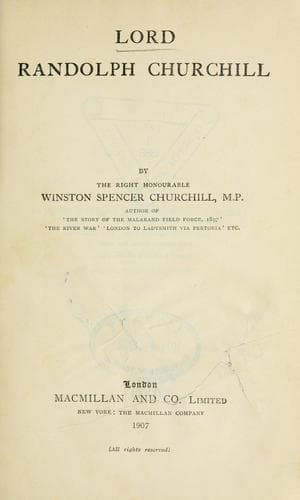
Churchill, Randolph Henry Spencer, Lord, 1849-1895
As the weakness and embarrassments of the Government and the dissensions
in the Cabinet became glaring, it was evident the end could not be
distant. But no one could tell when the moment would come; and the
imminent possibility of a transference of power forced grave
considerations into the minds of the chiefs of the Opposition. They
hated the Government. They believed its continuance to be deeply
injurious to the country. They were mortified by the dishonour which had
been inflicted on British arms and British reputation. The cry of their
supporters in the country for unceasing Parliamentary attack was
vehement. They were bound to fight their hardest. But, upon the other
hand, what if they succeeded? They could not dissolve, because of the
Reform Bill. Until the new registers for the reconstructed
constituencies had been prepared, and other indispensable mechanical
details settled, a General Election was physically impossible. Could
they, then, take office? Even if some Ministers were anxious to escape
from power, willing to ride for a fall--and this was certainly not the
disposition of the Prime Minister--the Government majority was enormous.
The only chance of overturning the Gladstone Administration was by a
division on some issue which should at once divide the Liberals and
secure the Irish vote. No mere lukewarmness on the part of
Ministerialists would suffice.
It was quite plain that an incoming Government, in a minority, without
the power of dissolution, brought into office by Nationalist votes,
could never carry a Coercion Bill through Parliament. But was a Coercion
Bill necessary? Mr. Gibson on whom the Conservatives relied as their
Irish authority, was of opinion that it would not be necessary. But
certainly Mr. Parnell could make it necessary! The question was long and
painfully debated. Clearly they had to fight. Not to do so was to
discourage the whole party on the eve of the election. Clearly they
might win. To refuse then to undertake the task, to admit that the
Conservative party had neither the men nor the cohesion to carry on the
Government, would equally injure them in the national estimation. It was
a grim dilemma. But the decision did not lie altogether in the hands of
particular men. Had it been possible for any one man to give orders
which would be obeyed with military discipline, he could not have
failed, were he a Conservative, to decide against any attempt to turn
out the Government; and, conversely, a Minister must have sought for any
decent pretext to resign. But the forces at work were not to be so
nicely governed. It is in the nature of Ministries to survive in spite
of their inclinations. It is in the nature of Oppositions to strive to
win, even in spite of their interests. Borne along by the stream, the
Conservative leaders determined to overthrow the Government if they
could, and they solaced themselves with Mr. Gibson’s assurances that the
state of Ireland did not require the renewal of the Crimes Act to
Public-domain text, read in full here on John Shaqi.
Reviews
Reviews
No reviews yet
Be the first to share your thoughts on this work.
Elsewhere in the archive
Join the Discussion
Join the discussion
Sign in to leave a comment or review.
Sign InorCreate an account