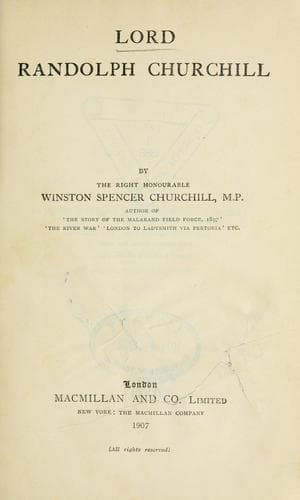
Churchill, Randolph Henry Spencer, Lord, 1849-1895
So far as the vote in the House was concerned, the Nationalists wanted
little temptation to turn out a Coercionist Liberal Administration. They
had long been looking for an opportunity of revenge. They shared the
general expectation that the lowering of the franchise would give a
great advantage to the Liberal party. Their interest was clearly, and
their intention was notoriously, to play for an equalisation in party
strength by supporting the weaker side at the dissolution. If the
Conservatives would give them any reasonable excuse for preferring them
to the Liberal Government, if they would avoid studied causes of
offence, the Irish party would be content to support them in the House
and to throw their vote--so far as it could be thrown--for the
Conservative candidates in the election. On some such tacit
understanding as this Lord Salisbury’s first Administration came into
power and held sway. Neither party gave away any point of practical
importance, or entered into any confidential relationship. Both Tories
and Nationalists pursued their own ends. They used each other for their
own purposes; and in the end the Conservatives came off the winners.
All suggestions of a more definite compact belong to the regions of
romance.
Within the space of a single year both great English parties were
supported by the votes of the Irish members and were to some extent
dependent on their good-will. But there was an important difference
between the relations which respectively existed. The Conservatives,
consciously or unconsciously, used the Irish party. The Liberals,
willingly or unwillingly, were used by them. And whereas the former
moved on through that association to prosperous years of power, the
latter sank into paralysis and decay. But it should not be inferred from
these unedifying reflections that Lord Randolph Churchill in his
declarations against the re-enactment of the Crimes Act in 1885 was
animated solely by a hard desire to effect a political combination. His
views on Irish men and Irish matters were very different in character
from the general opinion of his party. He knew Ireland well and liked
her people. He had been in former days the friend of Mr. Butt. For five
years of hard Parliamentary fighting he and his associates had sat in
front of the Irish Nationalists, and many a reciprocal service or
manœuvre had built up a House of Commons comradeship. ‘You can always
trust them,’ he used to say, ‘if you know them and understand them.’ In
office or Opposition, in good fortune or defeat, he detested the use of
special legislation in Ireland; and, although he remained an unwavering
opponent of Repeal, these pages will show that he at least did not
approach Irish questions in a spirit of selfish opportunism.
Public-domain text, read in full here on John Shaqi.
Reviews
Reviews
No reviews yet
Be the first to share your thoughts on this work.
Elsewhere in the archive
Join the Discussion
Join the discussion
Sign in to leave a comment or review.
Sign InorCreate an account