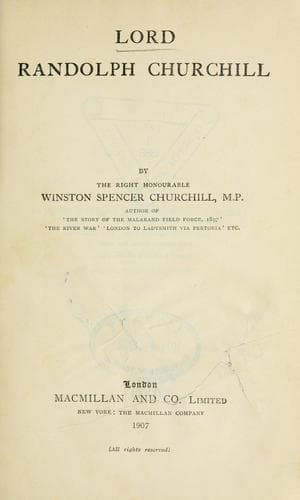
Churchill, Randolph Henry Spencer, Lord, 1849-1895
Lord Randolph’s votes and speeches during all the Coercion struggles of
the Parliament were, moreover, upon record. The Irish members, on their
part, knew that he had often supported them, to the detriment of his
reputation among his own friends, while the most brilliant
representatives of the Liberal Cabinet were scourging them without pity.
They remembered that he had always been civil and friendly to them in
days when scarcely any other English member would speak to them. They
were attracted by his stormy, rebellious nature. They delighted in his
attacks upon the Government. Parnell, we are told, liked him personally,
though their acquaintance was scanty. Among prominent English
politicians, he was at that time the best friend, and the only friend,
Nationalist Ireland could find. Any Government in which he was powerful
must be better than the Ministry from which Irish members had received
so much ill-usage. It was upon the opinion they had formed of him during
several years as a man, and upon their estimate of his influence with
his party, and not on any compact or bargain, that they acted in 1885.
In some fashion or another, however, Cabinet and Administration had held
together till the Whitsuntide holidays. The third period of the session
is dangerous to Governments. Most of the measures of the year, and
usually the Budget, are in the Committee stage and liable at any moment
to be challenged by a vote. At the same time, when vigilance is most
needed, a feeling of languor or exhaustion steals over the House of
Commons. With the advent of hot weather weary members seek escape from
London. Divisions are frequent; majorities precarious; an accident
always possible. Rumours had, however, gained acceptance that Cabinet
differences on Irish policy were not incapable of adjustment, and many
Liberal members thought that for the session at least the danger of
defeat was passed. But meanwhile a third and, as it proved, a fatal blow
had been aimed against the Ministry. An amendment to the Budget had been
framed at a meeting in Mr. Balfour’s house in Carlton Gardens, at which
Sir Michael Hicks-Beach, the Fourth Party, and Mr. Raikes alone were
present. It was approved by Lord Salisbury and Sir Stafford Northcote
and placed upon the paper in the name of Sir Michael Hicks-Beach. To a
casual observer the amendment might have appeared unimportant. It
condemned the proposed increase of the beer and spirit duties in the
absence of a corresponding increase in the duties upon wine, and
declined to add to the duty on real property without relief to the
rates. But it was, in fact, artfully and deliberately contrived to unite
the Opposition on an issue easily defensible in the country and likely
to secure support from the Irish and from the liquor interest in the
House. It acquired significance from a rumour that the Radical section
of the Cabinet had severely criticised Mr. Childers’s increase of the
Public-domain text, read in full here on John Shaqi.
Reviews
Reviews
No reviews yet
Be the first to share your thoughts on this work.
Elsewhere in the archive
Join the Discussion
Join the discussion
Sign in to leave a comment or review.
Sign InorCreate an account