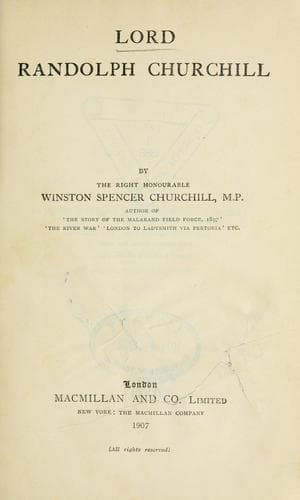
Churchill, Randolph Henry Spencer, Lord, 1849-1895
A threefold crisis now supervened: first, the national emergency,
arising from grave affairs in Egypt and with Russia, and the political
fermentation at home and in Ireland; secondly, a constitutional
situation peculiar and unprecedented in character; and thirdly, the
struggle within the Conservative party. All these operated
simultaneously and sympathetically affected each other. The Liberal
Administration was defeated on June 8. On the 9th Mr. Gladstone tendered
his resignation to the Queen. The Queen expressed surprise that he
should make his defeat a vital question and inquired whether, if Lord
Salisbury were unwilling to form a Government, the Cabinet would remain.
Mr. Gladstone replied that they would not remain. The Queen thereupon
accepted the resignations, which were announced to Parliament on the
12th, and sent for Lord Salisbury. Anticipating, or having private
notice of, the formal summons, Lord Salisbury had already approached
Lord Randolph Churchill through Sir Michael Hicks-Beach:--
June 10, 1885.
My dear Lord Randolph,--Lord Salisbury has asked me to tell you
that he would be very glad to talk to you on the general position,
if you would call on him: and I very much hope that no such ideas
as those which you seemed to entertain this afternoon will prevent
you from doing so.
I feel convinced (though I am not authorised to give you more than
my own belief) that he has asked no one to call on him, and that
his reason for not doing so is that he thinks that to do so would
be to usurp the position of leader, which no one has as yet
conferred on him.
It would be simply ridiculous that this idea on his part, combined
with your idea as to ‘place-hunting,’ should keep you two apart
just now.
Yours sincerely,
MICHAEL HICKS-BEACH.
And the next day, on the eve of his departure to Balmoral, Lord
Salisbury himself wrote:--
_Confidential._
20 Arlington Street, S.W.: Thursday, June 11, 4.45.
My dear Churchill,--I have just received a communication which
makes me anxious to see you. Could you call on me to-night after
dinner, or to-morrow morning?
Yours very truly,
SALISBURY.
Lord Randolph thought it better to defer his visit until after Lord
Salisbury had seen the Queen. His opinion had already been given as to
the conditions under which it would be desirable for the Conservatives
to take office, and was involved in the decision to try to turn out the
Liberal Government by means of the Irish vote on the Beach Amendment. He
had nothing new to say about that. If Lord Salisbury should decide not
to undertake the commission, there would be no necessity to raise the
thorny and painful questions connected with Sir Stafford Northcote.
Public-domain text, read in full here on John Shaqi.
Reviews
Reviews
No reviews yet
Be the first to share your thoughts on this work.
Elsewhere in the archive
Join the Discussion
Join the discussion
Sign in to leave a comment or review.
Sign InorCreate an account