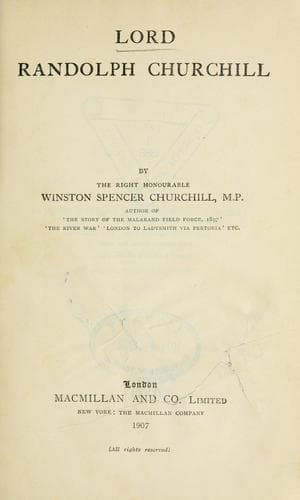
Churchill, Randolph Henry Spencer, Lord, 1849-1895
In ordinary circumstances Lord Salisbury’s course would have been
simple. He would have advised a dissolution of Parliament. This solution
was, however, impossible until November, owing to the Franchise and
Seats Acts. Therefore his legal and constitutional right of recommending
a dissolution was in abeyance; and, upon the other hand, the party of
which he was the head would be compelled, if he took office, to carry
the Budget, Supply, and other indispensable business of the year through
a House of Commons in which they were in a minority of nearly 100. Lord
Salisbury was so impressed by the difficulty of the situation that he
went to Balmoral with the intention of declining to form a Government.
At Balmoral, however, the Queen persuaded him to make the attempt if Mr.
Gladstone would not resume; and several attempts to induce Mr. Gladstone
to resume having failed, Lord Salisbury accepted the duty and returned
to London to discharge it. His first care was to seek from Mr. Gladstone
an assurance of support in the measures absolutely necessary to bring
the session to a close. The negotiations were protracted for many days;
but eventually Mr. Gladstone agreed that facilities for expediting
Supply might reasonably be provided, so long as the liberties of the
House of Commons were not placed in abeyance; and he added the
assurance that there was no idea on the part of the Opposition of
withholding the Ways and Means required for the public service. During
this discussion Lord Salisbury addressed himself to the formation of a
Government. He forthwith invited Sir Stafford Northcote to become
Chancellor of the Exchequer and Leader of the House of Commons; and Sir
Stafford Northcote agreed. He asked Sir Michael Hicks-Beach to be
Colonial Secretary; and Sir Michael Hicks-Beach agreed. Lord Salisbury
then applied to Lord Randolph Churchill, whom he desired to take the
India Office. But Lord Randolph refused to join the Government if Sir
Stafford Northcote continued to lead in the House of Commons.
From this position nothing could move him. He remained silent and
stubborn. While Lord Salisbury was still undecided whether to go on
without him or not, Sir Michael Hicks-Beach intervened. He was, in his
own words, ‘deeply impressed with the conviction that Lord Randolph
Churchill’s active assistance as a member of the Government was vital to
any hope of Conservative success at the General Election, for his
popularity with the new electorate was greater than that of any other
member of the party’;[29] and therefore, as soon as he learned that Lord
Randolph had refused to join, he told Lord Salisbury--though without
Lord Randolph’s knowledge, and entirely without pre-arrangement of any
kind--that in the altered circumstances he could not join either. The
dead-lock was again complete.
Public-domain text, read in full here on John Shaqi.
Reviews
Reviews
No reviews yet
Be the first to share your thoughts on this work.
Elsewhere in the archive
Join the Discussion
Join the discussion
Sign in to leave a comment or review.
Sign InorCreate an account