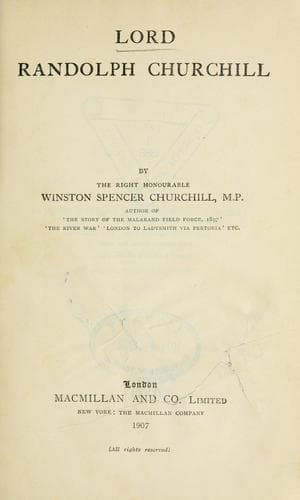
Churchill, Randolph Henry Spencer, Lord, 1849-1895
‘1. For a long time there had been a division of opinion in the
Conservative party on the question of the leadership--on the question as
to whether Lord Salisbury or Sir Stafford Northcote ought to be the
head of any Conservative Administration which events might bring into
existence. While, on the one hand, there was a unanimous recognition by
the party of the sterling worth and high character of the latter, there
was, on the other, an equally unanimous but certainly not equally
expressed opinion that he was indisposed by nature and training to place
himself in entire harmony with the intense and acute party polemics of
the moment; that he was, as he once admitted in a public speech,
“deficient in go”; and that Lord Salisbury, though he was much less
personally known to members of the House of Commons and much less
popular than Sir Stafford, was more qualified for the conduct of a
pitched battle such as we had to face.
‘I had identified myself with this latter opinion, and had expressed it
publicly and privately in one way and another since the year 1883. In
that year I had committed myself to such an extent that my action was
much resented by the party in the House of Commons, who adopted and
presented to Sir Stafford an address expressing their full confidence in
and great admiration of him. My belief is that in this controversy, the
existence of which was notorious, the principals had no share; that Sir
Stafford and Lord Salisbury behaved with the utmost loyalty to each
other, and remained throughout on the most intimate and friendly terms.
‘In June 1885, the crucial moment came. Mr. Gladstone resigned. “Whom
would the Queen send for?” was a question in everyone’s mouth. Lord
Salisbury was sent for. His intention was, if he formed a Government,
that Sir Stafford should become Leader of the House of Commons. To this
proposition, when proper opportunity offered, I declined to agree,
adhering to my former opinions as to the indisposition of Sir Stafford
for acute party warfare. Whether I was right or wrong I do not argue;
public opinion in the party and outside was certainly not with me, and
soon after, and since, I have been strongly drawn to the conclusion that
I was in error. The fact remains for record: I declined to take office
unless there was a change in the leadership of the party in the House of
Commons.
Public-domain text, read in full here on John Shaqi.
Reviews
Reviews
No reviews yet
Be the first to share your thoughts on this work.
Elsewhere in the archive
Join the Discussion
Join the discussion
Sign in to leave a comment or review.
Sign InorCreate an account