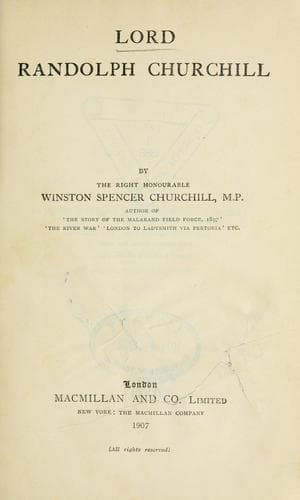
Churchill, Randolph Henry Spencer, Lord, 1849-1895
The narrative must here be somewhat interrupted, so far at least as
chronology is concerned, to admit Lord Randolph Churchill’s own account
of his action. He left behind him a considerable memorandum from which I
quote all that is relevant to this situation.
‘In the events,’ he wrote (as I should judge, early in 1889, though the
paper is undated), ‘which led to the formation of the Conservative
Government in June 1885, I bore a part, and am induced to record my
recollection of their nature; for one reason among others, that in my
belief they were the main cause which led to the adoption by Mr.
Gladstone of the policy of Repeal.
‘In the spring of 1885 it was a matter of notoriety among well-informed
and studious politicians that the question as to the expediency of the
renewal by the Government then in power of the Irish Crimes Act--which
was to expire in September[30]--was one on which the Cabinet could come
to no agreement. In the speeches which I made in the month of May at the
St. Stephen’s Club and at Bow I endeavoured by diffuse examination of
the question to do what I could to add to the difficulties which in
connection with this subject embarrassed the Ministry.
‘My remarks at the former place were followed by a decisive intimation
from Mr. J. Morley that he would oppose any measure for the renewal of
any portion of the Crimes Act. This intimation practically terminated
the duration of Mr. Gladstone’s Government. Agreement in the Cabinet on
this question became impossible. The Ministers determined to court
defeat in Parliament as a method of escape from the dilemma by
resignation. A General Election was impending and the Opposition eagerly
clutched at any opportunity of discrediting and defeating the Liberal
party, and with this eagerness I was in thorough accord. Two attempts to
place Ministers in a minority failed--one arising out of the events in
the Soudan, the other out of a dispute concerning election expenses and
local rates. A third attempt, against the Budget, met with unexpected
success. The hostility of the licensed victuallers, who considered
themselves aggrieved by Mr. Childers’s financial proposals, and the
almost admitted connivance of Lord Richard Grosvenor, then the Head Whip
of the Liberal party, secured the absence from the division of some
sixty or more members of the Ministerial forces. The Government was
placed in a minority and resigned.
‘The Opposition now found themselves in a position of immense
difficulty, and though the difficulty had been foreseen by the leaders
it was not on that account in any degree diminished.
‘The difficulty was twofold: personal and political.
Public-domain text, read in full here on John Shaqi.
Reviews
Reviews
No reviews yet
Be the first to share your thoughts on this work.
Elsewhere in the archive
Join the Discussion
Join the discussion
Sign in to leave a comment or review.
Sign InorCreate an account