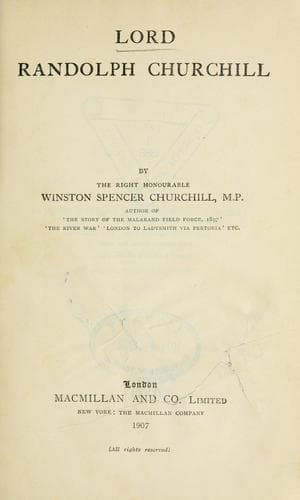
Churchill, Randolph Henry Spencer, Lord, 1849-1895
Men who presume to deal with great affairs must cultivate an unyielding
disposition. It is easy to withstand the reproaches or attacks of
opponents; but the honest advice of a friend and well-wisher at once
disinterested and experienced saps the foundations of judgment. There
was one appeal which must have greatly disturbed Lord Randolph. Nothing
in his private life was more striking and constant than his affection
for his mother and his respect for her opinion. ‘I have been thinking,’
she wrote (June 14), ‘very quietly and calmly over your position, and I
think you might go to see Lord Salisbury before his meeting, to show him
your friendly feeling while you maintain your own position. You see, in
the winter you felt acutely he did not consult or notice you. He may say
on this critical occasion he came to you before anyone else and offered
you one of the highest places in his Cabinet, and you refused your
assistance. Yesterday he sends his secretary to bid you to go to his
meeting. This, from reasons, you are obliged to decline. But do you not
think you owe him some explanation?... He told you to consider his
offer; so that, it seems to me, you are almost in duty bound to go to
see him; and if you simply refrain from going, he will think you
decidedly hostile. There is no doubt he is in a very difficult position,
and may say you require _not_ any policy or special measure, but simply
that he should _kill_ an old friend whom _all_ respect.... I do hope you
may be guided rightly.’
But Lord Randolph Churchill remained unresponsive. No communication of
any kind passed between him and Lord Salisbury until the crisis was
ended.
‘At this time,’ writes a Bencher of the Middle Temple, ‘an event
occurred which strangely evidenced the strength of Lord Randolph’s
popularity. But a description of the scene needs some explanation.
Amongst the Inns of Court the Middle Temple is fortunate in the
possession of a Hall grand in its construction and rich in evidence of
associations extending over seven centuries. In this Hall, during Term
time, the barristers and students dine. From amongst the barristers a
governing body, called the Benchers, is selected. On the Grand Day of
the summer Term the Benchers entertain distinguished guests at a
sumptuous banquet held in the Hall. On these occasions Benchers and
guests enter the Hall walking two and two, in procession, to the Daïs,
upon which they dine. After the dinner is concluded, in like procession
they leave the Hall, walking throughout its full length from the Bar to
the door which leads to the Parliament Chamber.
‘A Grand Day of the Middle Temple occurred on June 10, 1885. Never
before or since has so remarkable a company gathered within that Hall.
Public-domain text, read in full here on John Shaqi.
Reviews
Reviews
No reviews yet
Be the first to share your thoughts on this work.
Elsewhere in the archive
Join the Discussion
Join the discussion
Sign in to leave a comment or review.
Sign InorCreate an account