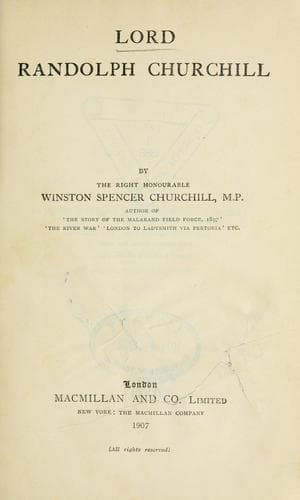
Churchill, Randolph Henry Spencer, Lord, 1849-1895
Yet while resources were still slender the difficulties and dangers of
the situation were tremendous. The dispute with Russia about the Afghan
boundary was in its most critical stage. For at least two months the
Cabinet faced the chance of war with a formidable military Empire. The
triumphant Mahdi was ravaging the Soudan, and Egypt, withdrawn behind
her narrowest frontiers, was threatened without and utterly disorganised
within. The British finances were oppressed by a deficit. Ireland
smouldered. All the elements of Irish national life were banded together
under the supreme authority of Parnell and that efficient Protestant
rebel was methodically preparing his campaign for an Irish Parliament.
In the English provinces Mr. Chamberlain, released from such partial
restraint as official obligations had hitherto imposed, unfolded the
‘Unauthorised Programme’ to an exulting Radical democracy. And behind
all ‘two million intelligent citizens,’ newly enfranchised, impatiently
awaited the opportunity of casting their votes. Such were the perils and
embarrassments amid which the ‘Ministry of Caretakers’ came into being.
Nor was it strange that eminent politicians were willing to prophesy
that after a brief and inglorious career they would be ‘swept off the
face of the earth.’ But Lord Salisbury, reminding the House of Lords
that several of the longest Administrations in English history had come
into being under precarious conditions, and fortifying himself by the
examples and experiences of Mr. Pitt in 1784, of Lord Liverpool in 1812,
and of Lord Palmerston in 1855, addressed himself to his heavy task with
serene determination.
The Fourth Party was translated bodily to a higher sphere. Lord Randolph
Churchill became Secretary of State for India--at that time, with the
exception of the Foreign Office, the most anxious and important of all
Ministerial posts. Mr. Balfour, though not admitted to the Cabinet, was
appointed President of the Local Government Board. Sir Henry Wolff was
despatched on a special mission to Turkey and Egypt with wide and
peculiar authority over the whole field of Egyptian affairs. Mr. Gorst
accepted the position of Solicitor-General. Three out of the four
friends who had worked together more or less harmoniously in Opposition
were sworn Privy Councillors upon the same cushion; and it was also
noticed that an unusual proportion of the thirty-five members who had
voted with the Fourth Party in the division upon Sir Henry Wolff’s
motion during the _interregnum_ were included in the Government.
Public-domain text, read in full here on John Shaqi.
Reviews
Reviews
No reviews yet
Be the first to share your thoughts on this work.
Elsewhere in the archive
Join the Discussion
Join the discussion
Sign in to leave a comment or review.
Sign InorCreate an account