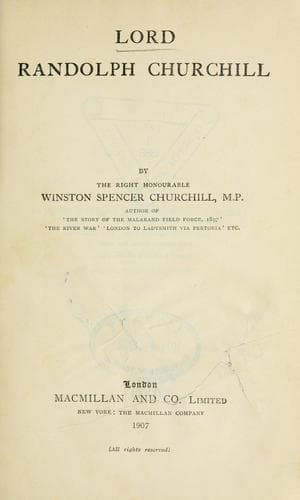
Churchill, Randolph Henry Spencer, Lord, 1849-1895
Lord Randolph’s popularity was enhanced by his promotion. Those
commanding qualities which the House of Commons had so frankly accepted,
and Tory Democracy so loudly proclaimed, were now recognised by persons
and by classes who had hitherto schooled themselves to regard him merely
as an unedifying example of irresponsible audacity. The vigorous
assertions of youth were stamped with the seal of official authority and
over all hung the glitter of success. His friends, old and new, hastened
to offer their congratulations. One of his acknowledgments may be
recorded:--
June 25, 1885.
Dear Mr. Tabor,--I was so pleased to receive this morning your kind
letter and I trust that your congratulations may be to some extent
justified by results. As it is the fact that whatever of success I
may have attained is mainly owing to the six years which I passed
at Cheam, may I ask as a favour for a holiday for all those young
gentlemen who are now deriving from you similar advantages to those
which befell me? It would be a pleasure to me to know that I have
not asked anything which was not in your power to grant.
Yours most sincerely,
RANDOLPH S. CHURCHILL.
Now that Lord Randolph had accepted ‘an office of profit under the
Crown’ his seat at Woodstock was vacated and he had to submit himself to
re-election. The leaders of the Liberal party did not encourage
opposition to Ministers in such circumstances at this juncture. When
they had themselves forced upon the Conservative party the task of
Administration, it seemed factious to impede the return of individuals
necessary for that purpose. Moreover, they were sensible of the
advantage which almost always accrues to anyone who is singled out for
attack by the opposite side. But the personality of the candidate gave
promise of distinction to his opponent, the nice balance of parties in
the old Borough held out a hope of success, and Mr. Corrie Grant hurried
down from London to voice the hot and not unreasonable resentment of the
Radical rank and file. This gentleman appealed to the electors upon a
single issue. It was not, he declared, a fight of politics against
politics, or of principle against principle--it was a fight against a
man. The statements and expressions which Lord Randolph had employed
against the Liberal party, its leaders, and in particular Mr. Gladstone,
made it necessary at all costs to challenge his return.
Public-domain text, read in full here on John Shaqi.
Reviews
Reviews
No reviews yet
Be the first to share your thoughts on this work.
Elsewhere in the archive
Join the Discussion
Join the discussion
Sign in to leave a comment or review.
Sign InorCreate an account