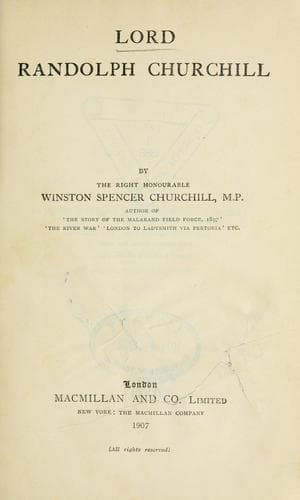
Churchill, Randolph Henry Spencer, Lord, 1849-1895
There were, notwithstanding, several reasons for uneasiness as to the
result. The absence of the candidate was an undoubted drawback. The
propaganda of Mr. Joseph Arch had produced a considerable impression
upon a section of the labourers. A more formidable consideration was the
attitude of the Duke of Marlborough. Lord Randolph’s father had wielded
immense personal influence in the borough and had neglected nothing that
might constitutionally be done to secure the return of his nominee. Two
years before, the new Duke would no doubt have exerted himself to the
utmost to help his brother; but the sale of the Blenheim pictures had
produced a serious quarrel in the family. Lord Randolph had vehemently
protested against the dispersal of so many of the treasures for which
Blenheim had been famous and a complete estrangement had ensued. The
Duke, moreover, after the opposition which had been threatened to his
candidature for the Carlton, had relapsed into political independence.
He now declared himself so strictly neutral during the contest that Lady
Randolph and the friends who came down to fight the election for her
husband, were fain for the first night of their arrival to shelter at
the Bear Hotel. Sir Henry Wolff’s diplomacy soon proved equal to those
difficulties. Friendly relations were restored; Blenheim opened its
gates to the Conservatives; and the Duke, stung by a statement in the
press that he had himself been a party to Mr. Corrie Grant’s
candidature, finished by lending his carriages to convey Lord Randolph’s
supporters to the poll. The election was nevertheless fought under some
disadvantage as compared with former occasions.
But the Secretary for India found in Lady Randolph and in his sister,
Lady Curzon, a mainstay of support and enthusiasm. ‘I should be very
glad,’ he wrote to his wife on June 29, ‘if you could arrange to stay in
Woodstock till Friday. If I win, you will have all the glory.’ Driving
about the widely extended constituency in a smart tandem profusely
decorated with pink ribbons, well known to most and with a smile for
all, these ladies canvassed indefatigably from morn till night. Their
Primrose badges--still an object of amusement in high Tory circles--were
the first to be worn in actual political warfare; and their influence,
supplying as it did that personal element without which enthusiasm is
scarcely ever excited, became a factor in the fight, against which the
eloquence of two Liberal ladies from Girton--specially imported to meet
the emergency--was utterly unable to prevail.
The result of the election was announced on the evening of July 3:--
Lord Randolph Churchill 532
Mr. Corrie Grant 405
Public-domain text, read in full here on John Shaqi.
Reviews
Reviews
No reviews yet
Be the first to share your thoughts on this work.
Elsewhere in the archive
Join the Discussion
Join the discussion
Sign in to leave a comment or review.
Sign InorCreate an account