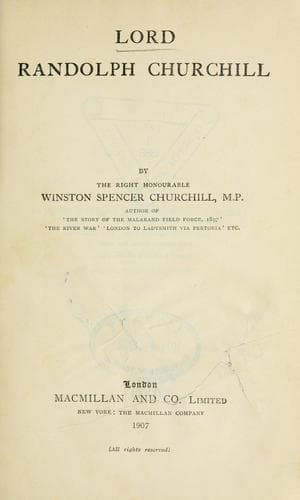
Churchill, Randolph Henry Spencer, Lord, 1849-1895
The majority for Lord Randolph Churchill was 127, or more than double
that by which he had been returned in 1880. Needless to relate, the
declaration of the poll was received with the utmost satisfaction by the
crowd in front of the Bear Hotel, to whom Lady Randolph, Lord Curzon,
Sir Henry Wolff, and later on Mr. Corrie Grant made brief but
appropriate speeches; and the fact that over six hundred ‘result
messages’ were despatched from the local post-office that evening showed
the interest taken by the world at large in this the last of the
Woodstock elections.
Even before Lord Randolph was re-elected for Woodstock, he was required
in the House of Commons. Portentous extracts were read from his speeches
as a private member, and his secretary in the House was cross-questioned
about them. Did he still adhere to his charges against the Khedive? Were
his views on Ireland what he had declared them to be at Edinburgh? To
all such inquiries Lord Randolph sent a simple answer, which may be
recommended to others similarly circumstanced: ‘I neither withdraw nor
apologise for anything that I have said at any time, believing as I do
that anything which I may have said at any time was perfectly justified
by the special circumstances of that time, and by the amount of
information I may have had in my possession.’
The new Ministers met Parliament with general statements of their views
and intentions on July 6. In both Houses they made a good appearance.
They achieved at once the requisite pomposity of public utterance, and
handled power as to the manner born. To the Peers Lord Salisbury
declared that the pledges of any British Government were sacred, and
that all existing obligations would be faithfully observed in the
further conduct of the negotiations with the Court of Russia. In answer
to the taunt, made out-of-doors, that the Conservatives would postpone
the date of the election for the purpose of prolonging their enjoyment
‘of what some persons are pleased to call the sweets of office,’ he
invited Lord Granville to admit that the new Government had endeavoured
to amend the Redistribution Bill so as even to accelerate the
dissolution. Lord Carnarvon justified the attempt to govern Ireland
under the ordinary law by statistics which showed the diminution of
agrarian crime. He spoke of former statesmen who had failed in
Ireland--‘so many that the wrecks of them lie strewn about’--and he
seemed to wrestle modestly, but hopefully, against the conviction that
he himself would be added to the number. In the Commons Mr. Bradlaugh
again presented himself and was received by the new Leader of the House
with the usual resolutions of prohibition and exclusion, affirmed by the
usual majorities. The next day Sir Michael Hicks-Beach explained the few
uncontentious legislative projects which the Government would try to
carry through and asked for the time of the House to enable them to wind
up the business of the Session. Mr. Gladstone declared that the request
Public-domain text, read in full here on John Shaqi.
Reviews
Reviews
No reviews yet
Be the first to share your thoughts on this work.
Elsewhere in the archive
Join the Discussion
Join the discussion
Sign in to leave a comment or review.
Sign InorCreate an account