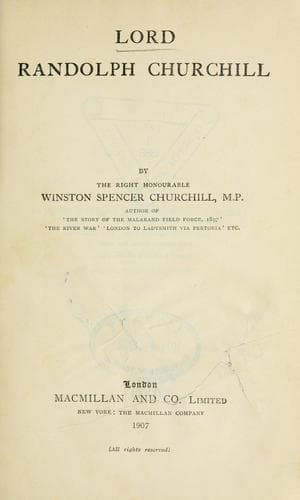
Churchill, Randolph Henry Spencer, Lord, 1849-1895
Almost as soon as the formation of the new Cabinet was complete Mr.
Parnell moved (July 17) a resolution reflecting on Lord Spencer and
demanding a fresh inquiry. Sir Michael Hicks-Beach opposed this
resolution in the name of the Government; but at the same time he said
that it was the right of every prisoner at any time to appeal to the
Lord-Lieutenant for the reconsideration of his sentence. ‘The present
Lord-Lieutenant [Lord Carnarvon] has authorised me to state that, if
memorials should be presented on behalf of those persons referred to in
this motion, they will be considered by him with the same personal
attention which he would feel bound to give to all cases, whether great
or small, ordinary or exceptional, coming before him.’ That was all; and
it may not seem a very large concession to Irish national feeling, but
it was enough to draw upon the head of the Minister a storm of reproach.
Sir William Harcourt, undisturbed by the significant absence of Mr.
Chamberlain and Sir Charles Dilke, rose to express the indignation of
the Liberal party that law and order should be subverted to political
expediency and the decision of a Viceroy impugned. These sentiments were
received with undisguised approval on the Conservative benches. Lord
Randolph Churchill replied. So far as he was personally concerned his
task would have been easy. He, at least, had consistently supported the
Irish demand for an inquiry. He was to defend in office a smaller
concession than he had urged in Opposition. But what with Ulster
growlings, sympathetically echoed by the Tory party on the one hand, and
on the other the plain need of Nationalist good-will, if peace and order
were to be maintained in Ireland under the ordinary law, the path was
not easy to find and perilously narrow to tread. His speech, in fact,
resolved itself into a series of depreciatory comments upon Lord
Spencer’s administration. Sir William Harcourt had spoken of it with
pride. ‘We were proud of the administration of Lord Spencer.’ Who did
‘_we_’ include? It was the prerogative of royalty to speak in the plural
number. Sir William Harcourt had once before electrified the country by
claiming royal descent. Was it in that exalted character that he used
the ‘we,’ or did he mean that the late Cabinet were united in their
admiration of Lord Spencer’s Viceroyalty? The division list would show.
For himself he had had no confidence in the administration of Lord
Spencer. For that reason he had a year before voted in favour of an
inquiry into this particular case. The new Government ought not
unnecessarily to go out of their way to assume responsibility for the
acts of the late Administration. They would now pronounce no opinion
upon the merits of the case. The new Lord-Lieutenant would inquire
carefully and impartially into it; and pending that inquiry, having full
confidence in Lord Carnarvon, Ministers would vote against the motion of
Mr. Parnell which seemed to prejudge the issue. On this Mr.
Public-domain text, read in full here on John Shaqi.
Reviews
Reviews
No reviews yet
Be the first to share your thoughts on this work.
Elsewhere in the archive
Join the Discussion
Join the discussion
Sign in to leave a comment or review.
Sign InorCreate an account