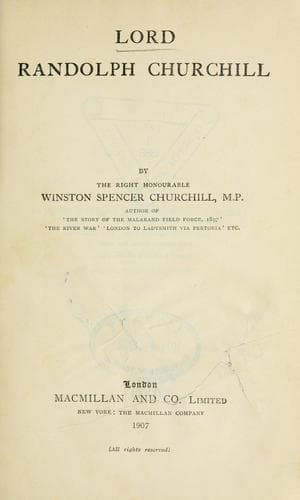
Churchill, Randolph Henry Spencer, Lord, 1849-1895
One harsh note jarred upon the ears of these Elysian legislators. The
new Ministers had scarcely taken office before the shadowy relations
which existed between the Conservative Government and the Irish party
issued in a substantial form. Nationalist opinion in Ireland had long
been excited over one of those dark and curious police cases the
savagely disputed details of which are thrust from time to time before
the House of Commons, to the bewilderment of British members. In August
of 1882 a whole family of the name of Joyce had, with the exception of
one young boy, been murdered under circumstances of peculiar atrocity at
Maamtrasna. Ten men were arrested upon the evidence of three witnesses
who professed to have seen them enter the house in which the crime was
committed. This evidence was confirmed by two of the prisoners who
turned approvers. After three successive trials three men were condemned
to death and executed, and the remaining five, having pleaded guilty,
received death sentences, afterwards commuted to penal servitude for
life. So far the story was grimly simple. But it was now alleged that
two of the murderers hanged had, in their dying depositions, declared
the innocence of the third, Myles Joyce; while this man himself had
protested always and to the last that he was not guilty. One of the
informers next came forward and swore that he had been told by an
official that his evidence would not be accepted by the Crown unless it
applied to all the prisoners, that he was given twenty minutes to
decide, and that then from ‘terror of death’ he had been induced to
swear away the life of Myles Joyce. An appeal from the Archbishop of
Tuam to the Lord-Lieutenant had led to an inquiry by Lord Spencer and
this inquiry resulted in the conclusion that the verdict and sentence
were right and just.
Hatred of a Coercion Viceroy and the profound distrust which divided all
who administered the law in Ireland from the mass of the people,
magnified this squalid tragedy into a political issue of importance. It
was asserted that as a result of Coercionist procedure and the
overweening desire of the Government to secure convictions, not only had
an innocent man been done to death, but that some of those still in
prison had been wrongfully convicted. When the case was raised in
Parliament during the Autumn Session of 1884, the Government,
representing the vote as one of confidence or want of confidence in Lord
Spencer, refused all further inquiry. In this they were generally
supported by both great parties and the Irish motion was rejected by 219
to 48. But Lord Randolph Churchill, Sir Henry Wolff, and Mr. Gorst had
voted in the minority with the Nationalists and Lord Randolph had spoken
strongly in their favour.
Public-domain text, read in full here on John Shaqi.
Reviews
Reviews
No reviews yet
Be the first to share your thoughts on this work.
Elsewhere in the archive
Join the Discussion
Join the discussion
Sign in to leave a comment or review.
Sign InorCreate an account