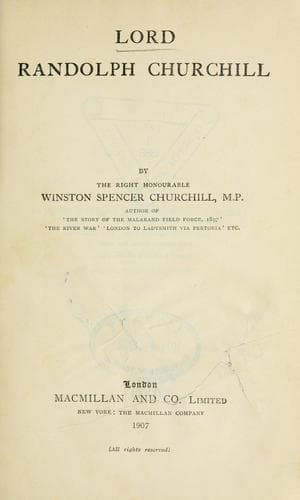
Churchill, Randolph Henry Spencer, Lord, 1849-1895
Heavy censures have been laid upon Lord Randolph Churchill for his share
in this affair. The Maamtrasna inquiry has often been described as part
of the purchase price paid by the Conservative party to Irish
Nationalism for power. On this a word may be said. Although no bargain
of any kind existed, it is obvious that Lord Salisbury’s
Government--which had come into office upon Nationalist votes, which was
forced to govern Ireland by the ordinary law, and which possessed no
majority in the House of Commons--was dependent largely upon Nationalist
good-will. To preserve that good-will was vital to their power to bring
the necessary work of the expiring Parliament to a creditable conclusion
and to the success of their struggle with Mr. Gladstone. Many other
issues of domestic and Imperial politics, far greater in their
importance than Irish affairs, were at stake in the approaching
election. The times were tempestuous; the need was great; the concession
pitifully small. In the event, Lord Carnarvon received, considered, and
in due course rejected the memorials which were sent him. No decision
was reversed; no prisoners were released; but the Irish people,
satisfied that the inquiry had been fair, accepted its conclusions. It
would not be difficult, from another point of view, to justify on its
merits an examination into the administration of justice in an island
which for five years had lain in the grip of what was almost martial
law, where the most elementary civil rights had been in abeyance and
where nearly every safeguard of British judicial procedure had been
destroyed--more especially when that examination was demanded by
recognised representatives from a Government of which they were in a
sense constituents. This is, however, to raise questions beyond the
scope of these pages. The merits of the Maamtrasna inquiry will be
variously appraised. Lord Salisbury’s first Administration must
collectively share the responsibility, as they shared the advantage.
But, whether right or wrong, Lord Randolph Churchill’s personal
sincerity cannot be doubted by anyone who reads his consistent
declarations upon this and kindred Irish subjects or who studies his
life and opinions as a whole.
The feeling excited among the Ulster members and so largely shared by
orthodox unbending Conservatives was not concealed. The _Standard_
abused the Tory leaders in the Commons as vigorously as any Liberal
newspaper. Lord Randolph Churchill had promised to attend a great
meeting at Liverpool at which Conservative working men from all parts of
Lancashire were to present him with a great number of addresses. July 29
was fixed for the ceremony. On the afternoon of the 28th he learned that
Lord Claud Hamilton, one of his old opponents in the National Union
fight, and another local member declined to attend. Regarding this as a
deliberate insult to the Government and to himself, he telegraphed at
once to the Chairman of the meeting:--
Public-domain text, read in full here on John Shaqi.
Reviews
Reviews
No reviews yet
Be the first to share your thoughts on this work.
Elsewhere in the archive
Join the Discussion
Join the discussion
Sign in to leave a comment or review.
Sign InorCreate an account