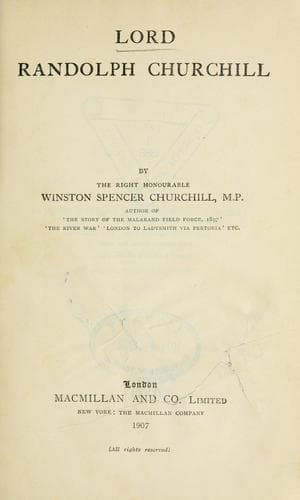
Churchill, Randolph Henry Spencer, Lord, 1849-1895
_Telegram from Lord Randolph Churchill to A. B. Forwood, Esq._
Lord Claud Hamilton has just informed me that he and Mr. Whitley do
not intend to be present at the meeting to-morrow, assigning as
their reason that they disapprove so strongly of the policy of the
Government on Irish questions that, if they were present, they
would be obliged to express publicly their disapproval. Under
these circumstances I distinctly decline to attend a meeting of the
Tory party in Liverpool at which the two senior members refuse to
be present. I think it in the highest degree ungenerous and
unpatriotic that two gentlemen professing Tory principles should
show at a difficult and critical time such a deplorable want of
confidence in a Government which, in all other parts of the United
Kingdom, has received from its friends a hearty and cordial
sympathy.
From this determination the most frantic appeals from Liverpool failed
to move him, and the meeting was abandoned at the last moment, to the
great disappointment and inconvenience of all concerned. The Lancashire
Tories were not, however, to be discouraged from their purpose and
resolutions were immediately passed by the Liverpool Conservative
Association inviting Lord Randolph to another similar meeting a few
weeks later and urging the local members to attend.
The relations of Ministers with the Irish party which were thought so
improper by good Conservatives, and were certainly compromising, did not
end with the Maamtrasna inquiry. The appointment of Lord Carnarvon as
Viceroy had been a part of the general policy of concession to Irish
feeling which the new Government was forced to adopt. His opinions were
known to be sympathetic to Irish aspirations and he was for that reason
agreeable to the Nationalist party. That he had carried Federation in
Canada, had tried to carry it in South Africa, and was well known to be
familiar with the machinery of subordinate legislatures and Colonial
Parliaments, were facts not in those days devoid of significance. His
first speech, in the House of Lords, as Lord-Lieutenant had been a
declaration of the abandonment of Coercion and an appeal, in terms of
generous sincerity, for a kindlier feeling between the two countries.
Beginning thus, Lord Carnarvon was soon treading that path of hope and
peril which seems to possess an almost irresistible fascination for
English statesmen who are invited to watch at close quarters the
detailed workings of Irish administration.
Public-domain text, read in full here on John Shaqi.
Reviews
Reviews
No reviews yet
Be the first to share your thoughts on this work.
Elsewhere in the archive
Join the Discussion
Join the discussion
Sign in to leave a comment or review.
Sign InorCreate an account