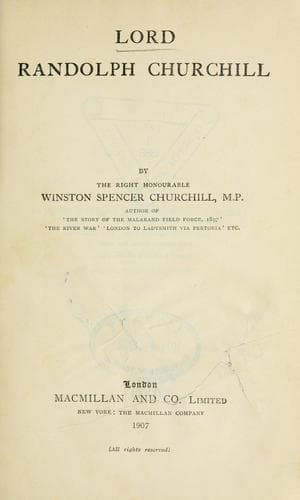
Churchill, Randolph Henry Spencer, Lord, 1849-1895
When Lord Carnarvon first explained this incident in the House of Lords
(June 10, 1886) he stated emphatically that he had had no communication
with the Cabinet on the subject either before or after the interview
took place and that he had received ‘no authorisation’ from the Cabinet.
Not until two years more had passed (May 3, 1888) did he reveal the fact
that he had acted throughout with Lord Salisbury’s consent. ‘I should
have been wanting in my duty if I had failed to inform my noble friend
at the head of the Government of my intention of holding that meeting
with Mr. Parnell, and still more should I have failed in my duty, if I
had not acquainted him with what had passed between us at the interview,
at the earliest possible moment. Accordingly, both by writing and by
words, I gave the noble Marquess as careful and as accurate a statement
as possible of what had occurred within twenty-four hours after the
meeting and my noble friend was good enough to say that I had conducted
that conversation with perfect discretion.’[32]
Lord Salisbury, however, kept this matter entirely to himself. No one of
his colleagues, not even the Leader of the House of Commons, was made
aware of the incident until the fact was declared in Parliament. Lord
Randolph Churchill was subsequently both astonished and offended at this
concealment of such an important political event from Cabinet Ministers
by the head of the Government.
The fact that Lord Carnarvon met Mr. Parnell and, with the knowledge and
assent of the Prime Minister, discussed at large with him projects of
Home Rule, has been held by many people to prove that the Tory Cabinet
was considering such a policy in the autumn. But, as Lord Salisbury
never apprised his colleagues of this interview, the inference is
obviously incorrect. No Home Rule proposals were ever submitted to the
Cabinet of 1885. Had proposals of this kind been submitted, taking the
form of the establishment of a Parliament in Ireland, the Cabinet would
inevitably have rejected them. If Lord Salisbury had been a convinced
Home Ruler he could not have imposed his view upon his colleagues.
Principle, prejudice, obstinacy, conviction, would each and all together
have paralysed him. Apart from the Irish Viceroy, the two Ministers who
might have been expected--according to prevailing impressions and
suspicions--to give the most favourable consideration to such proposals
were Lord Randolph Churchill and Sir Michael Hicks-Beach. It is certain
that both Lord Randolph and Sir Michael Hicks-Beach would have resigned
rather than support such proposals, still less be responsible for their
conduct through the House of Commons; and in resigning they would have
been followed by the great majority of their colleagues. If these two
leading Ministers had agreed with Lord Salisbury upon a plan, the
Cabinet would have broken in pieces; and even if the entire Cabinet had
agreed, it is by no means likely that they would have succeeded in
Public-domain text, read in full here on John Shaqi.
Reviews
Reviews
No reviews yet
Be the first to share your thoughts on this work.
Elsewhere in the archive
Join the Discussion
Join the discussion
Sign in to leave a comment or review.
Sign InorCreate an account