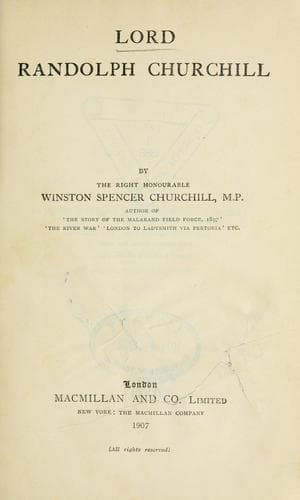
Churchill, Randolph Henry Spencer, Lord, 1849-1895
Lord Randolph Churchill was always inclined to blame Lord Ashbourne for
his absence from Ireland at this critical time. ‘The Irish Chancellor’s
constant presence in Dublin,’ he wrote in 1889 in the memorandum already
quoted, ‘might have been of inestimable service to the Viceroy and the
Government.... Lord Carnarvon, a nobleman of broad sympathies, liberal
mind, and warm imagination, was left alone, without any previous
knowledge of the country, to survey Ireland, to realise its condition,
to appreciate the difficulties of its government, under the influence
and guidance of Sir Robert Hamilton, at that time permanent
Under-Secretary, who was possessed of great ability and long experience
of the Civil Service, and who had some time previously arrived at the
conclusion that the concession of Home Rule in some shape or other was
inevitable. There was no countervailing influence of knowledge and
authority with the Viceroy such as Lord Ashbourne might have afforded
and Lord Carnarvon glided gently into the heresy which so grievously
embarrassed and damaged his colleagues and correspondingly strengthened
the party of Repeal.’
At the end of July Lord Carnarvon’s opinions were so far advanced that
he sought an interview with Mr. Parnell. The famous ‘empty house’
meeting was arranged. In a drawing-room in Grosvenor Square, dismantled
and deserted at the end of the London season, the representative of the
Queen in Ireland and the executive head of the Irish Government met the
man whom the mass of the English people, high and low, had been taught
during five years, by the leaders of both political parties, to regard
as guilty at least of high treason and probably of complicity in murder.
From the accounts which have since been made public, the conversation
that ensued seems to have been interesting and agreeable. Lord Carnarvon
carefully explained that he spoke for no one but himself, that he sought
for information only, and that as the Queen’s servant he could listen to
nothing inconsistent with the Union of the two countries. After this
formality had been assented to by Mr. Parnell, the two rulers of
Ireland--coroneted impotence and uncrowned power--rambled discursively
over such topics as self-government and national aspirations, Colonial
Parliaments and a central legislative body which might, it appeared,
possess--a remarkable licence--the right of protecting Irish industries.
Altogether a very instructive afternoon!
Public-domain text, read in full here on John Shaqi.
Reviews
Reviews
No reviews yet
Be the first to share your thoughts on this work.
Elsewhere in the archive
Join the Discussion
Join the discussion
Sign in to leave a comment or review.
Sign InorCreate an account