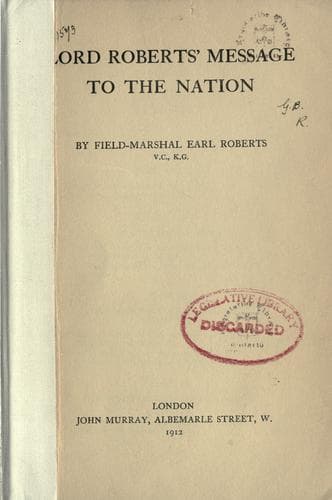
Lord Roberts' Message to the NationRoberts, Frederick Sleigh Roberts, Earl
History
Lord Roberts' Message to the Nation
Roberts, Frederick Sleigh Roberts, Earl
Great Britain -- Defenses; Great Britain. Army
Much has been said recently of the rights and the power of the workers
of this nation. We all, I hope, belong to that class--workers--but the
artisan class of the nation has been urged--and to you, the working men
of Manchester, I now specially address myself--you have been urged, I
say, to refuse to do your duties in war until your rights in peace are
granted. Gentlemen, I say to you, that is not the policy either of
Britishers or of men. I will go further: I say to you that it is not
by declining or shirking duty that you will extend your rights. He who
diminishes the power and vital resources of Great Britain diminishes
the power and the vital resources of every Britisher. How can you most
easily and most securely better yourselves as Britishers--as working
men? By making England better, by making it better worth your while to
be a citizen of, and a worker in that nation! If you seized by
violence or by Act of Parliament all the accumulated capital of the
centuries, you might have a madman's holiday for a time; but in the end
you would emerge bankrupt and starving. You yourselves are the capital
of the nation--the life-wealth of the nation--its manhood. Weapons,
however perfect, will not make an army. Men are necessary--men of
spirit, men of energy, loving their country, not merely loving their
class or themselves. And on you, in turn, that discipline and those
duties will confer unreckonable benefits. A tyranny imposes an
exterior restraint; but you, in your free democratic constitution,
should consider it as your privilege to impose upon yourselves from
within that discipline and those sacred duties.
I say to you, therefore, assert your rights as Britishers by demanding
the greatest, the highest of all civic and of all national rights--the
right to be taught to defend your country--the right, that is, to
defend your own honour as Britons and your liberties as citizens of
this Empire. Thus, and thus only, shall you be worthy of that Empire's
great past and of the dignity which that past confers upon every man of
you, whatever your position in life may be.
[1] Apart from Free Trade and unrestrained competition, there are three
other doctrines, or political principles, associated with the
Manchester School: (1) To maintain peace at any cost; (2) strictly to
avoid all interference with the internal affairs of foreign Powers; (3)
to subordinate as far as possible all other interests to the interests
of industry. The complete organization of industry was to have, as its
immediate consequence, the abolition of war. These principles
crystallized later into the familiar watchword of Liberalism: "Peace,
Retrenchment, and Reform."
Public-domain text, read in full here on John Shaqi.
Reviews
Reviews
No reviews yet
Be the first to share your thoughts on this work.
Join the Discussion
Join the discussion
Sign in to leave a comment or review.
Sign InorCreate an account