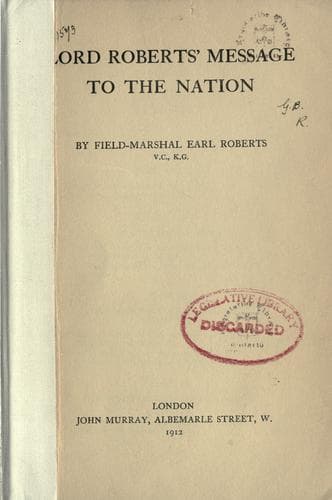
Lord Roberts' Message to the NationRoberts, Frederick Sleigh Roberts, Earl
History
Lord Roberts' Message to the Nation
Roberts, Frederick Sleigh Roberts, Earl
Great Britain -- Defenses; Great Britain. Army
The above, we trust, will be sufficient to dispose of the idea that
there is, or ever has been, any antagonism on the part of the League
towards the Territorial Force as a body. We contend that all
able-bodied men should be trained in it.
But, whilst we have from the beginning praised the organization of this
Force, whilst we have admired the patriotism and self-sacrifice of
those who have joined it, and encouraged our members to support it, we
do not conceal our opinion that, resting as it does on voluntary
enlistment alone, it can never become a Force on which the country can
rely for its protection in time of peril. Every year that passes
emphasizes the correctness of this view. The Territorial Force is in
the fourth year of its existence, and, despite the large measure of
support given to it and the unwearied labour of one of the ablest War
Ministers we have ever had, what is its condition? Its strength in
round numbers should be 314,000. It is 264,000. All its members
should do fifteen days' drill in camp every year. Only 155,300 have
done so this year. It should have 11,300 Territorial Officers. It has
only 9,500. Finally, 40 officers and 6,703 men were absent from camp
this year without leave.
We ask any open-minded man whether a Force thus constituted is an army
at all, much less an army to which this country can entrust its
existence as a great Nation?
We do not bring these facts forward in order to discredit Lord
Haldane's courageous efforts or to depreciate the patriotism of those
now serving in the Force. We bring them forward simply in order to
demonstrate the impossibility of constructing a defensive Army equal to
this country's needs on a basis of voluntary enlistment. If Lord
Haldane, backed by the hearty support of King and country, has
failed--and by his own admission he has failed--who is likely to
succeed?
Not many weeks ago this country was on the verge of a gigantic war.
And it was a war which, if it had come, would have come unexpectedly
and suddenly. What would have been our position? All the soothing
fallacies which pass current in time of peace--the belief that our
Expeditionary Force can at the same time be sent abroad and yet kept at
home to cover the training of the Territorial Force; the belief that
this Force is sure of six months' unmolested leisure in which it can
fit itself for the serious business of war--would have been shattered
in twelve hours. The Expeditionary Force--to be of any use at
all--must have been despatched abroad without a day's delay; and, for
the defence of these islands, we should have had to rely upon a handful
of Regulars left behind in the depots as "unfit"; such of the Special
Reserve as may not be required for the Expeditionary Force, and the
National Reserve; but mainly upon a Territorial Force,[1] nominally
264,000 strong, untrained for war, and further weakened by a shortage
of 1,800 officers!
Public-domain text, read in full here on John Shaqi.
Reviews
Reviews
No reviews yet
Be the first to share your thoughts on this work.
Join the Discussion
Join the discussion
Sign in to leave a comment or review.
Sign InorCreate an account