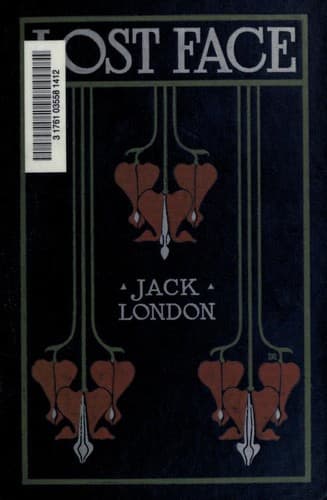
Adventure stories, American; American fiction -- 20th century; Short stories; Western stories
Day had broken cold and grey, exceedingly cold and grey, when the man
turned aside from the main Yukon trail and climbed the high earth-bank,
where a dim and little-travelled trail led eastward through the fat
spruce timberland. It was a steep bank, and he paused for breath at the
top, excusing the act to himself by looking at his watch. It was nine
o’clock. There was no sun nor hint of sun, though there was not a cloud
in the sky. It was a clear day, and yet there seemed an intangible pall
over the face of things, a subtle gloom that made the day dark, and that
was due to the absence of sun. This fact did not worry the man. He was
used to the lack of sun. It had been days since he had seen the sun, and
he knew that a few more days must pass before that cheerful orb, due
south, would just peep above the sky-line and dip immediately from view.
The man flung a look back along the way he had come. The Yukon lay a
mile wide and hidden under three feet of ice. On top of this ice were as
many feet of snow. It was all pure white, rolling in gentle undulations
where the ice-jams of the freeze-up had formed. North and south, as far
as his eye could see, it was unbroken white, save for a dark hair-line
that curved and twisted from around the spruce-covered island to the
south, and that curved and twisted away into the north, where it
disappeared behind another spruce-covered island. This dark hair-line
was the trail—the main trail—that led south five hundred miles to the
Chilcoot Pass, Dyea, and salt water; and that led north seventy miles to
Dawson, and still on to the north a thousand miles to Nulato, and finally
to St. Michael on Bering Sea, a thousand miles and half a thousand more.
But all this—the mysterious, far-reaching hairline trail, the absence of
sun from the sky, the tremendous cold, and the strangeness and weirdness
of it all—made no impression on the man. It was not because he was long
used to it. He was a new-comer in the land, a _chechaquo_, and this was
his first winter. The trouble with him was that he was without
imagination. He was quick and alert in the things of life, but only in
the things, and not in the significances. Fifty degrees below zero meant
eighty odd degrees of frost. Such fact impressed him as being cold and
uncomfortable, and that was all. It did not lead him to meditate upon
his frailty as a creature of temperature, and upon man’s frailty in
general, able only to live within certain narrow limits of heat and cold;
and from there on it did not lead him to the conjectural field of
immortality and man’s place in the universe. Fifty degrees below zero
stood for a bite of frost that hurt and that must be guarded against by
the use of mittens, ear-flaps, warm moccasins, and thick socks. Fifty
degrees below zero was to him just precisely fifty degrees below zero.
That there should be anything more to it than that was a thought that
never entered his head.
Public-domain text, read in full here on John Shaqi.
Reviews
Reviews
No reviews yet
Be the first to share your thoughts on this work.
Join the Discussion
Join the discussion
Sign in to leave a comment or review.
Sign InorCreate an account