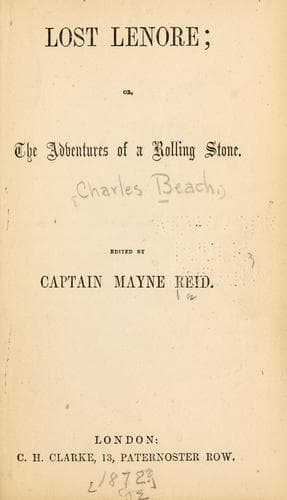
Lost Lenore: The Adventures of a Rolling StoneReid, Mayne
General
Lost Lenore: The Adventures of a Rolling Stone
Reid, Mayne
Adventure stories; Dime novels; Fiction
In the corps to which I belonged was a young man from the State of Ohio,
named Dayton. When the scamper towards the horses took place, instead
of running with the rest, Dayton walked leisurely along; and arrived
where the horses were tied, after every other individual in the company
had appropriated a steed. The only horse left for Dayton had also a
character--one that can only be described by calling him a sedate and
serious animal.
This horse had a sublime contempt for either whip or spurs; and
generally exercised his own judgment, as to the pace at which he should
move. That judgment equally forbade him to indulge in eccentric
actions.
Dayton proposed that we should exchange steeds--an offer that I gladly
accepted. When my absconding horse was brought back to the camp, I made
him over to Dayton, by whom he was at once mounted.
The animal tried the same movements with Dayton that had proved so
successful with me; but they failed. He was a good rider, and stuck to
his horse, as one of the men declared, "like death to a dead nigger."
The creature was conquered, and afterwards turned out one of the best
horses in the troop.
Volume One, Chapter VIII.
AN EPISODE OF SOLDIER-LIFE.
American authors have written so much about the Mexican war, that I
shall state nothing concerning it, except what is absolutely necessary
in giving a brief account of my own adventures--which, considering the
time and the place, were neither numerous nor in any way remarkable.
While in the service of the United States during that campaign, I was
the constant companion of Dayton. On the march and in the field of
strife, we rode side by side with each other.
We shared many hardships and dangers, and such circumstances usually
produce firm friendships. It was so in our case.
Dayton was a young man who won many friends, and made almost as many
enemies, for he took but little care to conceal his opinions of others,
whether they were favourable or not. Although but a private, he had
more influence among his comrades than any other man in the company.
The respect of some, and the fear of others, gave him a power that no
officer could command.
I did not see much of the war: as I was only in two actions--those of
Buena Vista and Cerro Gordo.
I know that some of the people of Europe have but a very poor opinion of
the fighting qualities of the Mexicans, and may not dignify the actions
of Buena Vista and Cerro Gordo by the name of battles. These people are
mistaken. The Mexicans fought well at Buena Vista, notwithstanding that
they were defeated by men, said to be undisciplined.
It has been stated in a London paper that the Mexicans are more
contemptible, as an enemy, than the same number of Chinamen. The author
of that statement probably knew nothing of either of the people he wrote
about; and he was thus undervaluing the Mexicans for no other reason,
than that of disparaging the small but brave army to which I belonged.
Public-domain text, read in full here on John Shaqi.
Reviews
Reviews
No reviews yet
Be the first to share your thoughts on this work.
Join the Discussion
Join the discussion
Sign in to leave a comment or review.
Sign InorCreate an account