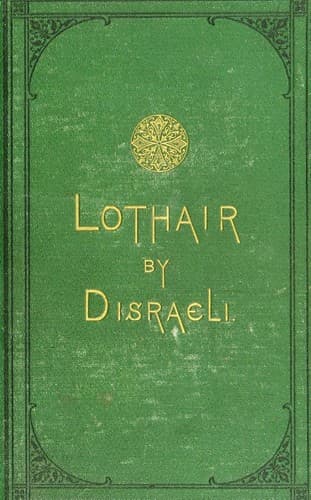
There was a ball at Lady Clanmorne’s in the evening, and Lothair was
present. He was astonished at the number of new faces he saw, the new
phrases he heard, the new fashions alike in dress and manner. He could
not believe it was the same world that he had quitted only a year ago.
He was glad to take refuge with Hugo Bohun as with an old friend, and
could not refrain from expressing to that eminent person his surprise at
the novelty of all around him.
“It is you, my dear Lothair,” replied Hugo, “that is surprising, not the
world—that has only developed in your absence. What could have induced
a man like you to be away for a whole season from the scene? Our
forefathers might afford to travel—the world was then stereotyped. It
will not do to be out of sight now. It is very well for St. Aldegonde to
do these things, for the great object of St. Aldegonde is not to be in
society, and he has never succeeded in his object. But here is the new
beauty.”
There was a stir and a sensation. Men made way, and even women
retreated—and, leaning on the arm of Lord Carisbrooke, in an exquisite
costume that happily displayed her splendid figure, and, radiant
with many charms, swept by a lady of commanding mien and stature,
self-possessed, and even grave, when, suddenly turning her head, her
pretty face broke into enchanting dimples, as she exclaimed: “Oh, cousin
Lothair!”
Yes, the beautiful giantesses of Muriel Towers had become the beauties
of the season. Their success had been as sudden and immediate as it was
complete and sustained. “Well, this is stranger than all!” said Lothair
to Hugo Bohun when Lady Flora had passed on.
“The only persons talked of,” said Hugo. “I am proud of my previous
acquaintance with them. I think Carisbrooke has serious thoughts; but
there are some who prefer Lady Grizell.”
“Lady Corisande was your idol last season,” said Lothair.
“Oh, she is out of the running,” said Hugo; “she is finished. But I have
not heard yet of any day being fixed. I wonder, when he marries, whether
Brecon will keep on his theatre?”
“His theatre!”
“Yes; the high mode now for a real swell is to have a theatre. Brecon
has the Frolic; Kate Simmons is his manager, who calls herself Athalie
de Montfort. You ought to have a theatre, Lothair; and, if there is
not one to hire, you should build one. It would show that you are alive
again and had the spirit of an English noble, and atone for some of your
eccentricities.”
“But I have no Kate Simmons who calls herself Athalie de Montfort,” said
Lothair. “I am not so favored, Hugo. However, I might succeed Brecon,
as I hardly suppose he will maintain such an establishment when he is
married.”
“I beg your pardon,” rejoined Hugo. “It is the thing. Several of our
greatest swells have theatres and are married. In fact, a first-rate man
should have every thing, and therefore he ought to have both a theatre
and a wife.”
Public-domain text, read in full here on John Shaqi.
Reviews
Reviews
No reviews yet
Be the first to share your thoughts on this work.
Elsewhere in the archive
Join the Discussion
Join the discussion
Sign in to leave a comment or review.
Sign InorCreate an account