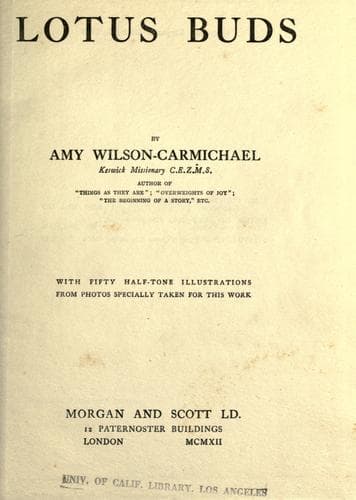
Children -- India; India -- Social life and customs; Missions -- India
All sorts of people help us in this work of saving the children. Once it
was a convert-schoolboy who saw a widow with a baby in her arms.
Noticing the bright large eyes, and what he described as the "blossoming
countenance of the child," he got into conversation with the mother, and
learned that she had been greatly tempted by Temple women in the town,
who had admired the baby and wanted to get it. "If I give her to them,
she will never be a widow," was the allurement there. The bitterness of
widowhood had entered into her soul, and poisoned the very mother-love
within her; and yet there was something of it left, for she did not want
her babe to be a widow. The boy, with the leisureliness of the East,
dropped the matter there; and only in a casual fashion, a week or so
later, mentioned in a letter that he had seen this pretty child, and
that probably, the mother would end in yielding to the temptation to
give her to the Temple--"but it may be by the grace of God that you will
be able to save her." We sent at once to try to find the mother; but she
had wandered off, and no one knew her home. However, the boy was stirred
to prayer, and we prayed here; and a search through towns and villages
resulted at last in the mother being traced and the child being saved.
Christian women have helped us. One such, sitting on her verandah after
her morning's work, heard two women in the adjoining verandah discuss
the case of a widow who had come from Travancore with a bright little
baby-girl, whom she had vowed she would give to one of our largest
temples. The Christian woman had heard of the Dohnavur nurseries, and at
once she longed to save this little child, but hardly knew how to do it.
She feared to tell the two women she had overheard their conversation,
so in the simplicity of her heart she prayed that the widow might be
detained and kept from offering her gift till our worker, old Devai,
could come; and she wrote to old Devai.
Happily Devai was at home when the letter reached her; otherwise days
would have been lost, for her wanderings are many. She went at once, and
found the mother most reasonable. Her idea had been to acquire merit for
herself, and an assured future for her child, by giving it to the gods;
but when the matter was opened to her, she was willing to give it to us
instead. In her case, as in the other, our natural instinct would have
been to try to make some provision by which the mothers could keep their
babies; but it would not have been possible. The cruel law of widowhood
had begun to do its work in them. The Temple people's inducements would
have proved too much for them. The children would not have been safe.
Public-domain text, read in full here on John Shaqi.
Reviews
Reviews
No reviews yet
Be the first to share your thoughts on this work.
Join the Discussion
Join the discussion
Sign in to leave a comment or review.
Sign InorCreate an account