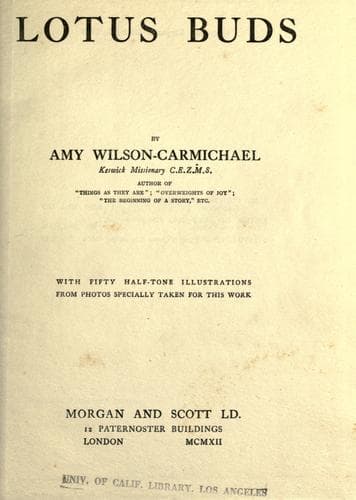
Children -- India; India -- Social life and customs; Missions -- India
The position was explained to him. But the Temple meant to him
everything that was worshipful. How could anything that was wrong be
sanctioned by the gods? The child's mother had been a devout Hindu; and
as we went deeper and deeper into things with him, it was evident he
became more and more reluctant to leave the little one with us. "Her
mother would have felt it shame and eternal dishonour." We were in the
little prayer-room, a flowery little summer-house in the garden, when
this talk took place. On either side are the nurseries, and playing on
the wide verandahs were happy, healthy babes; their merry shouts filled
the spaces in the conversation. Sometimes a little toddling thing would
find her way across to the prayer-room, and break in upon the talk with
affectionate caresses. To our eyes everything looked so happy, so
incomparably better than anything the Temple house could offer, that it
was difficult to adjust one's mental vision so as to understand that of
the Hindu beside us, to whose thought all the happiness was as nothing,
because these babes would be brought up without caste. In the Temple
house caste is kept most carefully. If a Temple woman breaks the rules
of her community she is out-casted, excommunicated. "You do not keep
caste! you do not keep caste!" the father repeated over and over again
in utter dismay. It was nothing to him that the babes were well and
strong, and as happy as the day was long; nothing to him that
cleanliness reigned, so far as constant supervision could ensure it,
through every corner of the compound. We did not profess to keep caste;
we welcomed every little child in danger of being given to Temples,
irrespective altogether of her caste. All castes were welcome to us, for
all were dear to our Lord. This was beyond him; and he declared he would
never have brought his child to us, had he understood it before. "Let
her die rather! There is no disgrace in death." As he talked and
expounded his views, he argued himself further and further away from us
in spirit, until he became disgusted with himself for ever having
considered giving the baby to us. All this time the baby lay asleep; and
as we looked at the little face and noted the "mother-want," the
appealing expression of pitiful weariness even in sleep, it was all we
could do to turn away and face the almost inevitable result of the
conversation. Once the father, a splendid looking man, tall and
dignified, rose and stood erect in sudden indignation. "Where is the
babe? I will take her away and do as I will with her. She is my child!"
We persuaded him to wait awhile as she was asleep, and we went away to
pray. Together we waited upon God, whose touch turns hard rocks into
standing water, and flint-stone into a springing well, beseeching Him to
deal with that father's heart, and make it melt and yield. And as we
waited it seemed as if an answer of peace were distinctly given to us,
and we rose from our knees at rest. But just at that moment the father
Public-domain text, read in full here on John Shaqi.
Reviews
Reviews
No reviews yet
Be the first to share your thoughts on this work.
Join the Discussion
Join the discussion
Sign in to leave a comment or review.
Sign InorCreate an account