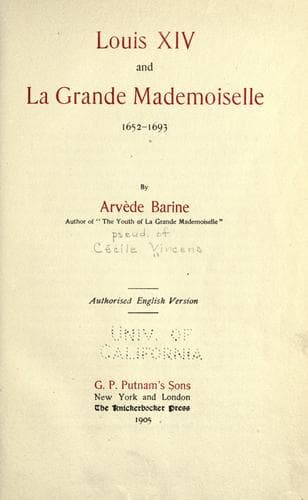
Louis XIV and La Grande Mademoiselle, 1652-1693Barine, Arvède
History
Louis XIV and La Grande Mademoiselle, 1652-1693
Barine, Arvède
Louis XIV, King of France, 1638-1715; Montpensier, Anne-Marie-Louise d'Orléans, duchesse de, 1627-1693
I see that you are already persuaded that success depends upon
my simple wish expressing my desire on one side or the other,
but I am not resolved to conduct myself according to the
caprices of those people.
I have told you that I sincerely wish your satisfaction and I
again affirm it. The friendship alone which I have for you
would give me this feeling, and I realise also that the scheme
is beneficial for me.
You must not doubt, therefore, that I will do all which will be
really useful in furthering the affair; as for the means, it is
not too much to say that I see better what should be done than
those who speak and write to you. However, I pray God, etc.
At Vincennes, September 2, 1664.
Signed; Louis.
The King spoke the truth: the Duc de Savoie did not want the Grande
Mademoiselle. Charles Emmanuel had never digested the affront received
upon the journey to Lyons, from which he had seen his sister return
Duchess of Parma when he had imagined to receive her as Queen of
France.[168] He was not averse to revenging himself on Louis XIV. by
refusing a princess of his family whose age above all "made him afraid,
for he desired children."[169]
He had also an account to regulate with Mademoiselle, who had disdained
him at the time in which she was young and beautiful. At this distant
date, Charles Emmanuel, although her junior by seventeen years, had not
concealed the fact that he would have been ready to marry her, "so much
did he esteem her person and also her great wealth."[170]
But it was with the Duc de Savoie as with the Prince of Wales, and later
with the Prince de Lorraine:
Quoi? moi! quoi? ces gens-la! l'on radote, je pense,
A moi les proposer! helas! ils font pitie:
Voyez un peu la belle espece.[171]
Having become less exacting with years, Mademoiselle at length found a
man who did not disdain to play the part of substitute for his betters.
The Duke remained firm, and it was again a Nemours,[172] sister of the
Queen of Portugal, who inherited the husband destined for the Grande
Mademoiselle.
Public-domain text, read in full here on John Shaqi.
Reviews
Reviews
No reviews yet
Be the first to share your thoughts on this work.
Elsewhere in the archive
Join the Discussion
Join the discussion
Sign in to leave a comment or review.
Sign InorCreate an account