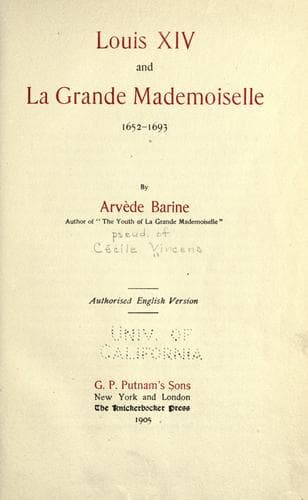
Louis XIV and La Grande Mademoiselle, 1652-1693Barine, Arvède
History
Louis XIV and La Grande Mademoiselle, 1652-1693
Barine, Arvède
Louis XIV, King of France, 1638-1715; Montpensier, Anne-Marie-Louise d'Orléans, duchesse de, 1627-1693
Equally difficult, the same fate fell upon Mademoiselle as upon the
marriageable daughter in La Fontaine: she was to be reduced to wed a
cadet of Gascony, the _malotru_ of the fable. I believe that La
Fontaine had Mademoiselle in his mind when writing _La Fille_. It has
been queried whether this subject was not borrowed from the _Epigram_ of
Martial. There is no need for so distant a search. On July 8, 1664, La
Fontaine had been appointed "gentleman-in-waiting to the dowager
Duchesse d'Orleans."[173] He was, therefore, in a position to be well
informed concerning the projects for marriage which failed, and the
ridiculous actions of the daughter of the house. We possess his
confidences upon the household of the Luxembourg, on the one side of the
apartments of Madame, on the other those of Mademoiselle, in an epistle
dedicated to Mignon, the little dog of his mistress.
For La Fontaine, the Luxembourg was the palace in which there was no
place for lovers. The tender passion was forbidden _chez_ Madame, where
it was necessary to be contented with the "pious smiles" of Mme. de
Crisse, the original of the Countess de Pimbesche, and to bear in mind
the presence of an old Capuchin become Bishop of Bethleem in
Nivernais,[174] who supervised the conversations. "Speak low," says the
letter _Pour Mignon_.
Si l'eveque de Bethleem
Nous entendait, Dieu sait la vie.
There was not even the resource of fleeing to the "Divinity" opposite.
Under that shelter, lovers were less well regarded year by year, and La
Fontaine divined why: the antipathy always evinced by Mademoiselle was
now doubled by envy.
The check in regard to the Savoie marriage had brought on a painful
crisis in the life of this poor unattached heroine. For the first time,
she had been made to feel that she had passed the marriageable age, and
she was one of those unfortunates who cannot easily resign themselves to
the fall from the purely feminine portion of existence.
The revolt against nature frequently causes whimsicalities; a terrible
injustice toward those doleful creatures who often have asked no better
than to obey nature's laws in becoming wives and mothers. Nervous
maladies give to the soul-tragedy a burlesque outside, and the world
laughs without comprehending. Mademoiselle was one of these
unfortunates. La Fontaine had well discovered it when he wrote:
Son miroir lui disait: "Prenez vite un mari."
Je ne sais quel desir le lui disait aussi:
Le desir peut loger chez une precieuse.
Public-domain text, read in full here on John Shaqi.
Reviews
Reviews
No reviews yet
Be the first to share your thoughts on this work.
Elsewhere in the archive
Join the Discussion
Join the discussion
Sign in to leave a comment or review.
Sign InorCreate an account