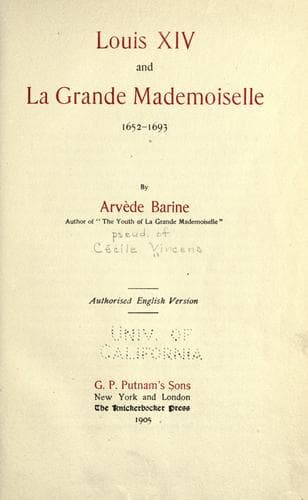
Louis XIV and La Grande Mademoiselle, 1652-1693Barine, Arvède
History
Louis XIV and La Grande Mademoiselle, 1652-1693
Barine, Arvède
Louis XIV, King of France, 1638-1715; Montpensier, Anne-Marie-Louise d'Orléans, duchesse de, 1627-1693
Paris followed with grief the course of her illness. Anne of Austria,
remaining without influence, had again become popular. "She preserves
harmony," wrote d'Ormesson, "and although she cannot be credited with
much good, she still prevents much that is evil" (June 5, 1665). It is
known that it was owing to her that a certain decency was maintained at
the Court of France; that without her, Louis XIV. and his sister-in-law
Henrietta would not have perceived in time that they already cared too
much for each other and that the rumour of this was "making much noise
at Court."[175]
[Illustration: =MADAME HENRIETTE D'ORLEANS= From the painting by Mignard
in the National Portrait Gallery (Photograph by Walker, London)]
The Queen Mother was forced to open eyes which wished to remain closed.
She had spoken frankly, and her plainness had perhaps saved the kingdom
of France from an ineffaceable stain. Such service cannot be forgotten
by honest people. To gratitude was added a sincere admiration for her
courage under suffering. The poor woman endured without complaint, and
with an incredible tranquillity, nine months of sharp pain increased by
the barbarous remedies applied by a crowd of quacks.
In the royal family, the sentiments were mixed. Louis XIV., as Mme. de
Motteville had well remarked, was a man full of "contradictions." He
cherished his mother. During a previous malady, a short time before the
cancer declared itself, he had cared for her night and day with a
devotion and also a skill which astonished the attendants.
The thought of now losing her gave him seasons of stifling sobs. At the
same time, his mother was a little too much of a personage. She troubled
him by her clairvoyance. He experienced a certain relief at the
knowledge that the time was approaching when she would no longer be able
to watch his course of life. In all probability, he was himself ignorant
of this feeling, but it was apparent to observers. When she was actually
dying, affection bore away all other considerations, and the King almost
fainted. Hardly was she interred when the pleasure of feeling himself
entirely free again became ascendant.
The attachment of Monsieur for his mother was his best emotion. His
grief possessed no hidden relief and forced him to be always near the
invalid's bed. "The odour was so frightful," reports Mademoiselle, "that
after seeing the wound dressed it was impossible to sup." Monsieur
passed all his time in the chamber and tried to demonstrate his
tenderness. Sometimes most ridiculous ideas occurred to him; but he was
not the less touching, through his never-failing tears, on account of
his sincerity.
Public-domain text, read in full here on John Shaqi.
Reviews
Reviews
No reviews yet
Be the first to share your thoughts on this work.
Elsewhere in the archive
Join the Discussion
Join the discussion
Sign in to leave a comment or review.
Sign InorCreate an account