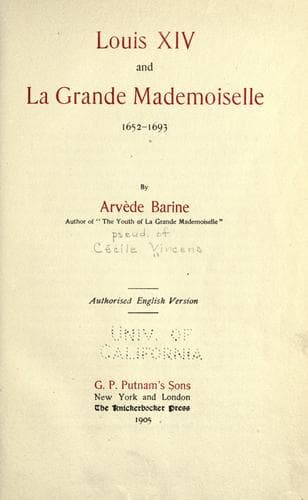
Louis XIV and La Grande Mademoiselle, 1652-1693Barine, Arvède
History
Louis XIV and La Grande Mademoiselle, 1652-1693
Barine, Arvède
Louis XIV, King of France, 1638-1715; Montpensier, Anne-Marie-Louise d'Orléans, duchesse de, 1627-1693
It is very difficult to relate the decline of the Grande Mademoiselle
without provoking a smile at least, and it would be a pity, however, if
this proud figure should leave the even slight impression of that of
Belise. She was left disabled, without aim in life, at the very moment
in which women in general were being excluded from action, after having
been slightly intoxicated with power under Anne of Austria. Men had at
that time encouraged women to enter into public life. Thanks to
masculine complicity, feminine influence and power had mounted high, and
the weaker sex enjoyed one of the most romantic moments of its entire
history.
The habit of treating women as the equals of men had been fully formed
when the will of a monarch who distrusted them precipitated the sex from
its giddy height.
It has been seen _a propos_ of La Valliere with what contempt Louis XIV.
spoke of women in his _Memoires_. Upon this subject he had truly
Oriental ideas, approaching those held by his Spanish ancestors,
inherited by them from the Moors. Louis could not do without women, but
he wanted them only for amusement. He did not really believe them
capable of giving anything else, judging them inferior and dangerous,
perhaps in remembrance of Marie Mancini, who had almost enticed him into
a crime against royalty.
Hardly had the King come to power when all who had issued from their
sphere must re-enter it. Love was the only affair of importance in which
women were permitted to share. Louis XIV. made no exception in favour of
his mistresses. Mme. de Montespan tyrannised a little over him in spite
of his fine theories. The others, however, were looked upon only in the
light of beautiful and amusing creatures.
When, towards the end of the reign, Mme. de Maintenon had the glory of
again raising the sex to the position of being esteemed by the King,
she alone benefited. In general, nothing was gained for women at large;
the impression in regard to their true position had been too deep.
Suddenly reduced to an existence with a narrow horizon, women found it
colourless and mean. They demanded love, since this was all that was
left to them to supply those violent emotions to which they had become
accustomed in the camps and councils. As the result of this new attitude
many strange events occurred, but they were little noticed as long as
the Queen Mother remained of this world. Anne of Austria succeeded in
saving appearances, if in nothing else. Once dead, there came the
downfall, and strange things became frightful ones.
It was at Versailles in the midst of the Bengal fires of the "Ile
enchantee" that the Queen Mother felt the first pangs of the cancer
which finally caused her death.
Public-domain text, read in full here on John Shaqi.
Reviews
Reviews
No reviews yet
Be the first to share your thoughts on this work.
Elsewhere in the archive
Join the Discussion
Join the discussion
Sign in to leave a comment or review.
Sign InorCreate an account