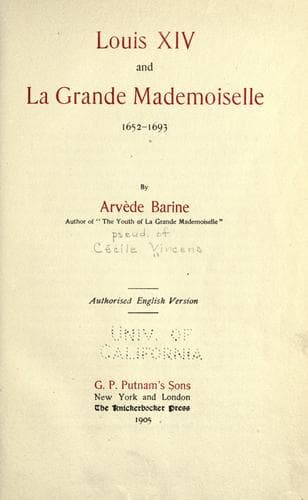
Louis XIV and La Grande Mademoiselle, 1652-1693Barine, Arvède
History
Louis XIV and La Grande Mademoiselle, 1652-1693
Barine, Arvède
Louis XIV, King of France, 1638-1715; Montpensier, Anne-Marie-Louise d'Orléans, duchesse de, 1627-1693
He enjoyed feeling free from those wearisome persons who had abused the
patronage of his mother in creating themselves censors of their
sovereign. No one except his confessor and his preachers concerned
themselves further with his sins. When Bossuet and Bourdaloue were
appointed Court preachers they restrained themselves but little; but
Louis XIV. bore their reproaches with equanimity. It was their duty, and
Christians of that date, even bad ones, recognised what they owed to the
Church, and bent their heads before the pulpit. Bossuet cried out in the
presence of the entire Court that "immoral manners are always bad
manners," and that "there is a God in heaven who avenges the sins of the
people, and who, above all, avenges the sins of Kings."[178] He launched
apostrophies at Mlle. de La Valliere: "O creatures, shameful idols,
withdraw from this Court. Shadows, phantoms, dissipate yourselves in the
presence of the truth; false love, deceitful love, canst thou stand
before it?"
Bourdaloue, who found Mme. de Montespan in the place of Mlle. de La
Valliere, reproached the King for his "debauches," and openly demanded
of him in his sermon if he had kept his promise of rupture: "Have you
not again seen this person fatal to your firmness and constancy? Have
you no more sought occasions so _dangerous_ for you?"
Mme. de Sevigne went one day to hear him at Saint-Germain, where he
preached a Lenten sermon before the King and Queen. She returned
confounded and angry at his boldness: "We heard after dinner the sermon
of Bourdaloue, who speaks with all his force, launching truths with
lowered bridle, attacking adultery on every side; regardless
of all, he rides straight on."[179] Louis XIV. accepted these
public reproaches without protest; there was, however, but little
result.
[Illustration: =MADAME DE MONTESPAN= From the engraving by Flameng after
the painting by Mignard]
One effect of the death of the Queen Mother was that rivals to Mlle. de
La Valliere were free to appear; also there was a great increase in the
number of charlatans and alchemists, who found more easily an
aristocratic clientele. Diviners and sorcerers also played an important
role in the love life of this society--the most polished in the world.
The practice of the magic arts was at that date considered one of the
most flourishing Parisian industries. The inhabitants of the streets
little frequented, or of the suburbs, were accustomed to the movement
which took place in the early morning, or in the evening at dusk, around
certain isolated houses.[180] People of all ranks, on foot, in carriages
or in chairs, women masked or muffled, succeeded each other before a
closed door, which only opened at a particular sign.
Public-domain text, read in full here on John Shaqi.
Reviews
Reviews
No reviews yet
Be the first to share your thoughts on this work.
Elsewhere in the archive
Join the Discussion
Join the discussion
Sign in to leave a comment or review.
Sign InorCreate an account