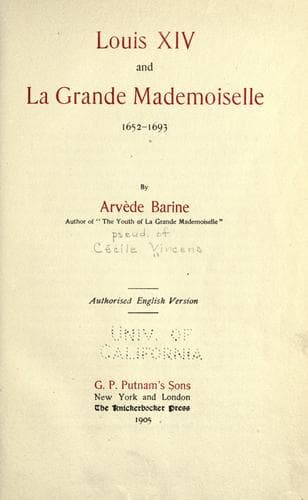
Louis XIV and La Grande Mademoiselle, 1652-1693Barine, Arvède
History
Louis XIV and La Grande Mademoiselle, 1652-1693
Barine, Arvède
Louis XIV, King of France, 1638-1715; Montpensier, Anne-Marie-Louise d'Orléans, duchesse de, 1627-1693
The state of mind which led this crowd to the clairvoyant was to be
found in all classes of society, from the highest to the lowest. Public
credulity was passing through a period of expansion, apparently very
much at odds with the splendid intellect of France at that date, at
which, however, those who believe the simple formulas of history will
not be astonished. Two of our grand classic writers have left pages
which bear witness to the extent of the evil, existing at the very
moment in which France became the actual head of Europe.
Moliere mocks at occult science and its adepts, through a long play, or
rather a libretto for a ballet,[181] which he wrote for the King in
1670, named as we already know, _Les Amants Magnifiques_. The _dramatis
personae_ are divided into two camps according to a rule of his own, in a
fashion very unpleasant for the grandees of this world, Moliere allowing
them the precedence in folly. It was sufficient for his heroes to be
illustrious through rank, to endow them with a blind faith in all
conjurers. "The truth of astrology," says the Prince Iphicrate, "is an
incontestable fact, and no one can dispute against the certitude of its
predictions." This is also the opinion of the Prince Timocles: "I am
sufficiently incredulous in regard to many things, but as for astrology,
there is nothing more certain and more constant than the success with
which horoscopes may be drawn." The Princess Aristione also agrees, and
is anxious in finding that her daughter is less convinced.
This is a commencement of a freedom of thought, and one cannot know to
what it may lead: "My daughter," says the mother, "you have a little
incredulity which never leaves you."
Disbelief in astrology and sorcery is represented in the play of
Moliere, figuring in the name of "Clitidas, court jester," and of
another person of obscure birth, "Sostrate, general of the army," who
takes the part of Clitidas against the calmer prophets and other
exploiters of human folly.
There is nothing more agreeable [says he] than all the great
promises of this sublime knowledge. To transform everything
into gold; to find immortal life; to heal by words; to make
oneself beloved by the person of one's desires; to know all the
secrets of the future; to call down from the sky at will
impressions upon metals which bear happiness to mortals[182];
to command demons; to render armies invisible and soldiers
invulnerable--all this is doubtless charming, and there are
people who have no trouble in believing in the possibility; it
is the easiest thing in the world for some men to be convinced,
but for me, I avow that my grosser mind has some difficulty in
comprehending and in believing.
Public-domain text, read in full here on John Shaqi.
Reviews
Reviews
No reviews yet
Be the first to share your thoughts on this work.
Elsewhere in the archive
Join the Discussion
Join the discussion
Sign in to leave a comment or review.
Sign InorCreate an account