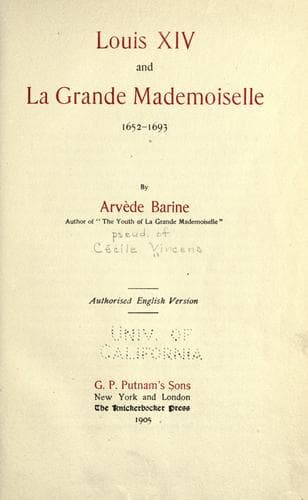
Louis XIV and La Grande Mademoiselle, 1652-1693Barine, Arvède
History
Louis XIV and La Grande Mademoiselle, 1652-1693
Barine, Arvède
Louis XIV, King of France, 1638-1715; Montpensier, Anne-Marie-Louise d'Orléans, duchesse de, 1627-1693
It is under this latter name that she became celebrated in the annals of
crime. La Voisin the fortune-teller is the same as La Voisin the
poisoner. At the date of the hosiery shop, she had not yet attracted the
attention of justice, in spite of her installation, but ill-assured, on
the Pont Marie, which obliged her to have a double domicile, or to give
rendezvous at the house of her confrere. She gained large sums of money.
The price for consultation varied from a single piece to several
thousand francs, or from an old rag to a necklace of precious stones,
and again she drew something from the acolytes of both sexes who
assisted in her wicked works. It was known from herself that her
property was held in her own right, her husband having been always
unfortunate in business. In spite of this precaution, the money slipped
through her fingers. It is true that she had expenses, children to bring
up and relatives to support. She said: "I have ten persons to feed," but
she was economical for others. La Voisin gave a crown a week to her
mother and brought up her daughter as a small shop-keeper. It was she
herself who, in company with other miserables of her own kind, spent
madly. The position of husband of a poisoner seems to have been a
precarious one. Antoine Montvoisin was familiar with the nature of his
wife's industry, but his conscience did not forbid his profiting by it
for his own comfort. His conscience also permitted him to appropriate
to himself money entrusted to him by his wife to execute the orders for
the _neuvaines_. He was as much a free-thinker as any of the Vardes or
Guiches, and convinced that the _neuvaines_ were absolutely useless. As
to going further, to putting his own "paw in the dish," he was
successfully prudent. He was never anxious; but he was actually daily in
danger of being poisoned, for La Voisin could not suffer this coward.
She would have liked to replace him by a veritable associate, and
between the pair, there were perpetual fights for pre-eminence in
deceit.
The good man Antoine would certainly have died through poisoning in
spite of all his care, if he had not conceived the ingenious idea of
uniting himself with an executioner, to whom he confided the situation.
It was agreed between the two that, if Montvoisin should die before his
wife, the hangman should speak and demand an autopsy. La Voisin became
afraid. She tried to poison her husband on a journey, but did not
succeed, and finally considered it safer to keep him with her.
She had benefited, as had also the entire corporation, by the hopes
awakened in the breasts of many of the pretty women among the
aristocracy by the death of the Queen Mother.
Public-domain text, read in full here on John Shaqi.
Reviews
Reviews
No reviews yet
Be the first to share your thoughts on this work.
Elsewhere in the archive
Join the Discussion
Join the discussion
Sign in to leave a comment or review.
Sign InorCreate an account