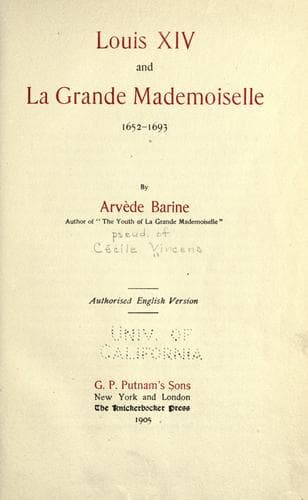
Louis XIV and La Grande Mademoiselle, 1652-1693Barine, Arvède
History
Louis XIV and La Grande Mademoiselle, 1652-1693
Barine, Arvède
Louis XIV, King of France, 1638-1715; Montpensier, Anne-Marie-Louise d'Orléans, duchesse de, 1627-1693
The clairvoyant counselled new-comers to go to the good Saint Denis,
always a succour for women unhappy in their domestic life, and to the
indefatigable Saint Antoine de Padua. She reserved until later the
giving of certain powders, only hinting at their existence, the secret
of which had been brought from Italy and which were sought at Paris by
both provincials and strangers.
It is now known through contemporaneous documents that arsenic was an
element in these powders, and that so many persons accused themselves in
confession of having "poisoned some one" that the priests of Notre-Dame
at length gave warning to the authorities (1673). Did the penitents,
especially the women, always speak the truth? Popular imagination is so
quickly fired when poisoning is suggested, that it may well be queried
whether a portion of the unfortunates were not rather hysterical and
victims of hallucinations. It is probable that the true answer will
never be known. Physicians at that time were the doctors of Moliere, and
the science of chemistry did not exist.
With the husband softened or suppressed, the women demanded love to
replace emotion in their contracted and faded existence. The task of the
necromancer thus consisted in interesting God or the devil in the heart
pangs of her client and of arousing an affection in the breast of the
man she designated. This was the beginning for the new clients; the end
was the black mass with its obscene rites or the bloody mass, for which
a small infant was strangled.
All the forms of conjuration were used between the two, every charm,
every talisman and many "kinds of powders," not always inoffensive. The
consultations were paid for according to the rank or fortune of the
clients. In default of money, a jewel was given or even a signed note,
the imprudence of which last proceeding it is hardly needful to point
out.
In the year of the death of Anne of Austria, one of the clairvoyants
most frequented was the wife of a hosier named Antoine Montvoisin, whose
shop was situated upon the Pont Marie, which to-day still unites the
right bank of the Seine with the isle Saint-Louis. The Pont Marie, as
almost all the bridges of Paris at that date, had a double row of
houses, with shops beneath, which formed a very animated street. The
affairs of Montvoisin, however, had not prospered. He had tried several
commercial undertakings without success. He had been dry-goods merchant
and jeweller, and had always "lost his shops," according to the
expression of his wife, Catherine Montvoisin, familiarly called "the
neighbour."
[Illustration: =LA VOISIN= From a print in the Bibliotheque Nationale]
Public-domain text, read in full here on John Shaqi.
Reviews
Reviews
No reviews yet
Be the first to share your thoughts on this work.
Elsewhere in the archive
Join the Discussion
Join the discussion
Sign in to leave a comment or review.
Sign InorCreate an account