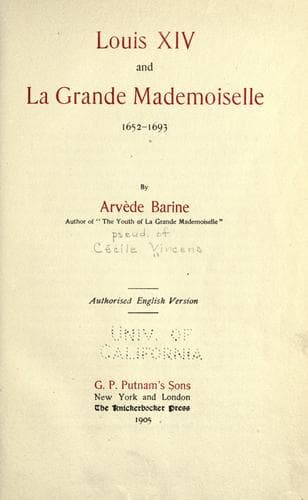
Louis XIV and La Grande Mademoiselle, 1652-1693Barine, Arvède
History
Louis XIV and La Grande Mademoiselle, 1652-1693
Barine, Arvède
Louis XIV, King of France, 1638-1715; Montpensier, Anne-Marie-Louise d'Orléans, duchesse de, 1627-1693
As we know, the _litterateurs_ who frequented the salon of Mademoiselle
were all enemies of Racine, half on account of loyalty to Corneille,
half on their own behalf, through an instinct of self-preservation.
Besides Menage and the Abbe Cotin, whom we have lately encountered
speaking frankly to each other, besides the amiable Segrais whose
literary powers were too light to lead him far, there was the Abbe
Boyer, whose tragedies Segrais desired to be pardoned, because he was a
"sufficiently good academician," and that worthy old man De Chapelain,
illustrious until the day upon which his verses went to press. There was
some reason for accusing Mademoiselle of having been the "centre of the
opposition to the new poetry."[199] To say this is, however, to
exaggerate her role. We shall see later that she was far too occupied in
living through her own tragedy to be actively interested in those being
enacted upon the boards. Loaded with injuries and calumnies by the
Vadius and the Trissotins, menaced with thrashings by the aristocratic
protectors of these great men of the salon, Racine ran the risk of being
crushed, and was saved only by the signal favour of the King. Neither he
nor Moliere would have accomplished their work if Louis XIV. had not
sustained them against all critics. This is a service for which we
should not limit our gratitude. The reflection upon this great debt
arouses a tenderness towards a Prince with whom we are otherwise not
always sympathetic.
It is possible that there was some politics in his attitude. The success
of writers so new fell in well with his design of making a _tabula rasa_
of the detested past: but after all the main reason for which protection
was accorded was affection.
When Louis XIV. laughed "even till his sides ached"[200] over the _Ecole
des Femmes_, at which amusement the devots and prudes were indignant,
when he saved the _Plaideurs_, almost hissed in the Hotel de Bourgogne,
by "bursts of laughter, so great that the Court was astonished,"[201]
there was no calculation: he was honestly amused, like any one else. It
was also a true and frank admiration which caused him to dry his tears
at _Iphigenie_, and to order the repetition of _Mithridate_. He loved
the "new" for two reasons: because he had good taste, and because the
heroes of the later writers were of the kind needful for his generation.
It has been seen how marvellously Moliere and the King understood each
other, and the mention of Racine recalls to us the profound phrase of
Heine. Racine revealed himself in the _Andromaque_ as the "first modern
poet." Hermione and Oreste have only a distant relationship with the
heroes of Corneille. They are already "those possessed by love, the
great passionates with whom love becomes a malady, who love to the brink
of crime, and even till death."
Public-domain text, read in full here on John Shaqi.
Reviews
Reviews
No reviews yet
Be the first to share your thoughts on this work.
Elsewhere in the archive
Join the Discussion
Join the discussion
Sign in to leave a comment or review.
Sign InorCreate an account