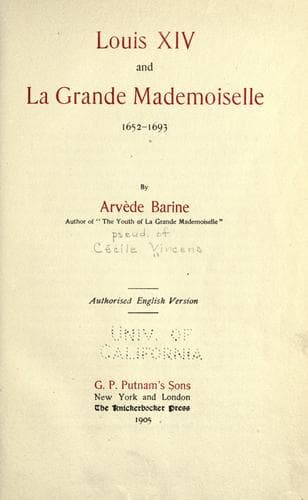
Louis XIV and La Grande Mademoiselle, 1652-1693Barine, Arvède
History
Louis XIV and La Grande Mademoiselle, 1652-1693
Barine, Arvède
Louis XIV, King of France, 1638-1715; Montpensier, Anne-Marie-Louise d'Orléans, duchesse de, 1627-1693
With these characters, it can be said that modern love, profound,
tender, melancholy, impregnated with soul, and at the same time troubled
by the obscure influences of the nervous life, makes its entrance into
French literature. Oreste shows a sadness, a despair, a madness, which a
century and a half later burst forth in love romances. Louis XIV. had
not waited for Racine for his education in passion. When Marie Mancini
fascinated him, he was one of the first examples of the modern type of
those "possessed by love," and he had never forgotten this crisis; in
fact he never forgot anything. This episode in the life of the young
King had been a good apprenticeship for the comprehending of the love of
Oreste or of Phedre as the true love malady, as a fatality against which
our single will is only a feeble weapon.
Around the King, Mme. Henriette, Mme. de Montespan, all the young Court
and some shrewd spirits of the old, with Conde at the head, rendered
justice to the truth of the "anatomies of the heart," in the tragedy of
Racine. Mademoiselle was incapable of this; she believed too firmly in
the superhuman strength of the heroes of Corneille, with whom the will
laughs at resistance, whether the opposition arises in the soul or in
the exterior world, to admit the fatality of passion. Nevertheless, it
was the Grande Mademoiselle herself who was going to demonstrate clearly
to all France that it was impossible to escape fate, when this fate
points to love. Here we meet the great misfortune of her life!
An atmosphere of passion, and an intimacy with people whose sole
occupation was to render themselves attractive, was somewhat dangerous
for an old maid, sensitive without realising it. Mademoiselle had the
singular desire, which later cost her dearly, to make an ally of Mme. de
Montespan and thus to form a part of the chosen society of the Court.
She sought the company of the mistress and received service from her.
Mme. de Montespan was her interpreter with the King. In return
Mademoiselle endeavoured to calm M. de Montespan who, for serious or for
trivial reasons[202] "flew into passions," like a "madman" or "wild
person," against Madame his wife. "He is my relative and I scolded
him," says the _Memoires_ of Mademoiselle. As a connoisseur,
Mademoiselle hugely enjoyed the original wit of Mme. de Montespan. The
pleasure found in returning the ball in conversation was the foundation
of the intimacy.
With the growing idleness of the Court, pleasure in pure cleverness
increased. The play of the mind was the sole resource against ennui.
Wit, no matter at whose expense, became the enjoyment. The wise and
prudent Mme. de Maintenon succumbed like Mademoiselle, when her turn
came, to the irresistible charm of a conversation which "renders
agreeable the most serious matters, and ennobles the most trivial."[203]
Public-domain text, read in full here on John Shaqi.
Reviews
Reviews
No reviews yet
Be the first to share your thoughts on this work.
Elsewhere in the archive
Join the Discussion
Join the discussion
Sign in to leave a comment or review.
Sign InorCreate an account