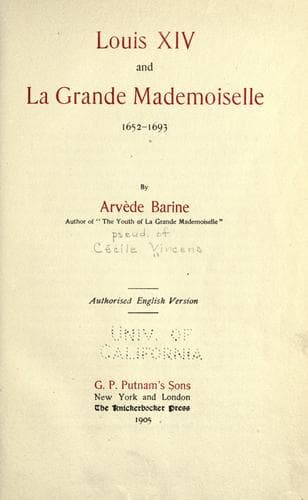
Louis XIV and La Grande Mademoiselle, 1652-1693Barine, Arvède
History
Louis XIV and La Grande Mademoiselle, 1652-1693
Barine, Arvède
Louis XIV, King of France, 1638-1715; Montpensier, Anne-Marie-Louise d'Orléans, duchesse de, 1627-1693
"The habit of respect was preserved without murmur," says again
Saint-Simon, who recalled Mme. de Montespan, disgraced and passing her
time in penitence, nevertheless continuing to hold court in her
convent,[207] with as royal an etiquette as at Saint-Germain or
Versailles:
The back of her armchair was formed by the foot-piece of the
bed, and there was no other chair in the room. Monsieur and the
Grande Mademoiselle had always loved her, and often went to see
her; for these, chairs were brought, and also for Madame la
Princesse; but Mme. de Montespan did not dream of deranging
herself for her own people nor for those they brought with
them.... One can judge by this how she received "all the
world."
The "all the world," which included some of the most distinguished,
contented themselves with small "chairs with backs," or simple camp
stools. No one was offended, and "all France came"; I do not know by
what fantasy it was considered a duty to make visits from time to
time. She spoke to each like a queen holding her court, who honours in
"addressing." Marie-Therese herself, in the time in which Mme. de
Montespan was the actual sovereign, had submitted to the long empire of
custom. In 1675, the fourth year of the war in Holland, Louis XIV. being
with the army while Mme. de Montespan was at her chateau at Clagny, one
of their sons was "slightly ill."[208] The Queen considered it her duty
to visit the child and to comfort the mother. She went to seek Mme. de
Montespan, and led her one day to the Trianon, another to dine in some
favourite convent, an example which brought the crowd to Clagny and made
an end of hesitancy. "The wife of her firm (_solide_) friend," wrote
Mme. de Sevigne, "visited her, and afterward the entire family in turn.
She takes precedence of all the Duchesses." (July 3, 1675.)
Public-domain text, read in full here on John Shaqi.
Reviews
Reviews
No reviews yet
Be the first to share your thoughts on this work.
Elsewhere in the archive
Join the Discussion
Join the discussion
Sign in to leave a comment or review.
Sign InorCreate an account