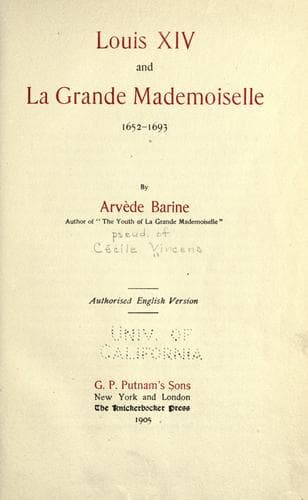
Louis XIV and La Grande Mademoiselle, 1652-1693Barine, Arvède
History
Louis XIV and La Grande Mademoiselle, 1652-1693
Barine, Arvède
Louis XIV, King of France, 1638-1715; Montpensier, Anne-Marie-Louise d'Orléans, duchesse de, 1627-1693
Fortunately, the latter virtues were deeply ingrained in the breasts of
the French gentlemen of this period, and it is not to their discredit if
the other faculties, mental and physical, the exercise of which was
plainly discouraged by the King, should have so fallen into disuse that
their children suffered. The final descendants of four or five
generations of those living this absurd life were the _emigres_ of the
great Revolution, all heroes, almost all clever, or at least appearing
so, and in general people of wit, but without character. This fact can
hardly be too much emphasised: never has a monarch laboured with greater
skill and method than Louis XIV. in the successful attempt to annihilate
the nobility and to ruin its reputation. This is one of the most serious
souvenirs of the wars of the Fronde.
It was with the women as with the men--the same subjection, the same
emptiness of life, from which arose the weakness of Mademoiselle for
Mme. de Montespan. The situation of recognised mistress "affects
nothing"; Mademoiselle had never considered that the virtue of others
concerned her. The novelty of the situation, the unexpected prerogatives
accruing to the new position, and the habits resulting, gave rise to
some of the most curious incidents of the reign, and also strengthened
an intimacy which survived many shocks.
As soon as Louis XIV. formally established his mistresses at Court, it
had been needful to frame new rules of etiquette. At first these rules
were understood rather than formulated, but contemporary writers give
evidence of their existence. It was the new regulations which gave
scandal, rather than the fact of a weakness too common to all men of all
times. The people had found the phrase suitable enough when it ran to
gaze on "the three queens" in one carriage; Mlle. de La Valliere and
Mme. de Montespan were publicly at the same time occupying the rank of
secondary wives to the King. When the royal family made its solemn
visits to any of its members who were mortally ill, these two ladies
arrived after the King and Queen. Mademoiselle met them at the death-bed
of Mme. Henriette; "Mme. de Montespan and La Valliere came." She met
them again over the cradle of a daughter of Louis XIV. and of
Marie-Therese, who died as an infant. "I found her in the last
extremity.... We staid almost the entire night watching her die; Mme.
de Montespan and Mme. de La Valliere were also there." The latter
escaped from such honours as often as she could. Mme. de Montespan liked
them better, and added to them. She had placed herself upon the footing
of the Queen in regard to ordinary visits, which she never returned.
"Never," says Saint-Simon, "not even to Monsieur or Madame or to the
Grande Mademoiselle, or to the Hotel de Conde."
The same hauteur was displayed in the manner of receiving the princes
and princesses of the blood, and this "exterior of Queen" followed her
into the retreat! All were accustomed to it.
Public-domain text, read in full here on John Shaqi.
Reviews
Reviews
No reviews yet
Be the first to share your thoughts on this work.
Elsewhere in the archive
Join the Discussion
Join the discussion
Sign in to leave a comment or review.
Sign InorCreate an account