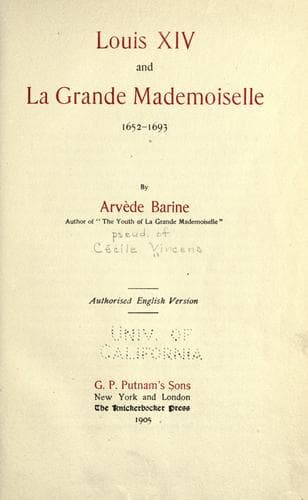
Louis XIV and La Grande Mademoiselle, 1652-1693Barine, Arvède
History
Louis XIV and La Grande Mademoiselle, 1652-1693
Barine, Arvède
Louis XIV, King of France, 1638-1715; Montpensier, Anne-Marie-Louise d'Orléans, duchesse de, 1627-1693
Lauzun attacked this delicate subject and did not hesitate to speak
unpleasant truths before offering the soothing balm held in reserve. It
was his habit to treat women brutally in order to make them submissive,
and in this case there were double reasons for doing so. "His maxim,"
relates Saint-Simon, "was that the Bourbons must be rudely treated and
the rod must be held high over their heads, without which no empire
could be preserved over them." This system had succeeded tolerably well
with Louis XIV. Lauzun could well believe, in these early times, that it
would also be successful with his cousin, so humbly did she accept his
harshness.
He said to her: "I find that you are right to take a husband, nothing in
the world being so ridiculous, no matter what may be the rank, as to see
a woman of forty wrapped up in the pleasures of the world, like a girl
of fifteen, who thinks of nothing else. At this age, a woman should be a
nun or at least a _devote_, or she should remain at home modestly
dressed."
He admitted that Mademoiselle, on account of her high rank, might
constitute an exception, and that she might be permitted at long
intervals to hear one or two acts of the opera; but her duty as old maid
was "to attend vespers, and to listen to sermons, to receive the
benediction, to go to assemblies for the poor, and to the hospitals." Or
else to marry; this was the alternative which pointed his moral. "For
once married," continued he, "a woman can go anywhere at any age; she
dresses like others, to please her husband, and goes to amusements
because he wishes his wife not to appear peculiar."
Every word impressed itself on the mind of the loving Princess. When
Saint-Simon, who was intimate with Lauzun, read the _Memoires_ of
Mademoiselle, he found the account of this adventure so true and lively
that he renounced the attempt to relate it himself. "Whoever knew Lauzun
will at once recognise him in all that Mademoiselle relates, and his
voice can almost be heard." Through a very natural contradiction, the
Grande Mademoiselle, even at the height of her passion, preserved "some
regret that she would no longer be queen in foreign lands." Lauzun tried
to banish this regret. He represented to her that the trouble of playing
at royalty
surpassed the pleasure. If you had been really Queen or Empress
you would soon have been bored.... You can now dwell here all
your life.... If you desire to marry you can raise a man to be
the equal in grandeur and power to sovereigns. Above all, he
will realise that you have taken pleasure in bringing him to
prominence; he will be deeply grateful. It would not be needful
to describe the man who may possess so much honour; for in pleasing
you and in being your choice, he must of necessity be an estimable
being. He will lack nothing; but where is he?
Public-domain text, read in full here on John Shaqi.
Reviews
Reviews
No reviews yet
Be the first to share your thoughts on this work.
Elsewhere in the archive
Join the Discussion
Join the discussion
Sign in to leave a comment or review.
Sign InorCreate an account