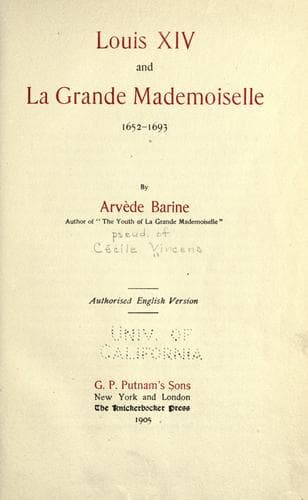
Louis XIV and La Grande Mademoiselle, 1652-1693Barine, Arvède
History
Louis XIV and La Grande Mademoiselle, 1652-1693
Barine, Arvède
Louis XIV, King of France, 1638-1715; Montpensier, Anne-Marie-Louise d'Orléans, duchesse de, 1627-1693
This language, so clear in its import to the reader, did not entirely
satisfy Mademoiselle. The poor Princess was ever expecting an avowal or
caresses which never came. Lauzun acted the disinterested friend, the
person who was entirely out of the running, and he detailed all the
reasons which made an unequal marriage distasteful to him. Far from
seeking her, he held himself at a respectful distance when he met her.
"It was I," says she, "who sought him." His reserve and his reticence
added fuel to the flames, and this diverted him, but for the moment he
did not dare to promise himself anything more than greater credit at
Court.
In the meantime, the Duchesse de Longueville[216] wished to establish
the Count de Saint-Paul, the one of her sons who resembled "infinitely"
La Rochefoucauld. In spite of the great difference in age--her son was
only twenty--she thought of Mademoiselle, who remained by far the best
match in the kingdom, and commenced overtures. These were eluded, but
with a gentleness which astonished the social world. Mademoiselle had
her reasons: "For myself, who had my own desires buried in my heart, it
did not at all vex me that the report should be spread that there was
question of marrying me to M. de Longueville.[217] It occurred to me
that this might in some measure accustom people to my future action."
For once, the diplomacy of Mademoiselle did not prove a failure, and her
calculations were found to be justified. Some days later, when the
affair was being discussed before Lauzun, one of his friends, who had
perceived that the Princess was listening with pleasure, asked him why
he did not try his fortune.[218] Others joined in the suggestion and all
assured him that nothing was impossible for a man so advanced in the
good graces of the King. Lauzun expressed himself shocked at the idea of
an alliance with Mademoiselle; but on returning to his lodging, he
ruminated the entire night upon this conversation, and from that time
the thought did not appear to him so chimerical. It was necessary,
however, to delay the assurance; the King led the Court into Flanders
and gave the command of the escort to his favourite.
This was a political journey. Spain had been vanquished almost without
resistance in the war of Devolution[219] (1667-1668). Louis XIV. deemed
it useful to display French royalty in all its pomp to the populations
lately united with his kingdom, by the treaty of Aix-la-Chapelle (May 2,
1668), and all prepared to make a fine figure in a spectacle whose
strangeness finds nothing analogous in modern life.
In 1658, Loret the journalist had valued at about twelve hundred souls
(the servitors were not included) the convoy formed by the Court at its
departure for Lyons. This figure was certainly surpassed in 1670, when
the royal family alone, more than complete, since it included Mme. de
Montespan and Mlle. de La Valliere, took in their train a suite of
several thousand persons, not counting the army of escorts.
Public-domain text, read in full here on John Shaqi.
Reviews
Reviews
No reviews yet
Be the first to share your thoughts on this work.
Elsewhere in the archive
Join the Discussion
Join the discussion
Sign in to leave a comment or review.
Sign InorCreate an account