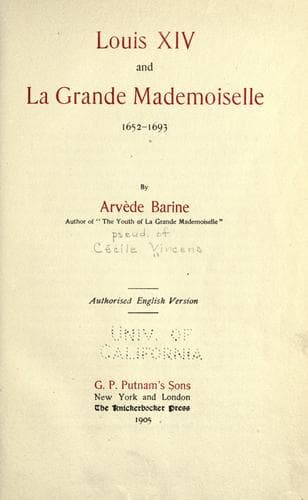
Louis XIV and La Grande Mademoiselle, 1652-1693Barine, Arvède
History
Louis XIV and La Grande Mademoiselle, 1652-1693
Barine, Arvède
Louis XIV, King of France, 1638-1715; Montpensier, Anne-Marie-Louise d'Orléans, duchesse de, 1627-1693
The couple profited by the warning. On Monday, December 15, 1670, in the
afternoon, the Ducs de Montausier and de Cregny, the Marechal d'Albret
and the Marquis de Guitry presented themselves before Louis XIV., and
demanded the hand of the Grande Mademoiselle for M. de Lauzun, "as
deputies from the French nobility, who would consider it a great
honour and grace if the King would permit a simple gentleman to marry a
Princess of the blood."[242] This proceeding was a plan of Lauzun's. It
succeeded with the King, and after he had been thanked in the name of
the entire nobility of the kingdom, Mademoiselle, who was apparently
listening to the reading of a sermon, behind the chair of the Queen, was
notified that M. de Montausier was asking for her. The Duke reported the
good reception which they had received and ended in these terms: "Your
affair is accomplished, but I counsel you not to let things lag; if you
follow my advice, you will marry this very night."
"I was convinced that he was right" adds Mademoiselle, "and I prayed him
to give the same advice to M. de Lauzun if he should see him before I
did."
There is no clearer fact in history than the evidence of the
consternation into which France was thrown by the news that the Duchesse
de Montpensier, granddaughter of Henri IV., was to marry the Comte de
Lauzun, "a simple (qualified) gentleman." To-day, an alliance of this
kind, provided it does not concern the heir to the throne, is only a
piece of society gossip, even in lands still profoundly loyal to
monarchical sentiments. In the seventeenth century such an event touched
so nearly the social hierarchy upon which all rested that Mademoiselle,
in thus confusing social ranks, appeared to have failed seriously in
her duty as Princess.
Louis, as King, had not considered it his duty to oppose. The criticism
was more severe inasmuch as custom, encouraged by illustrious examples,
offered to lovers separated by birth easy means for completing their
private happiness, sustaining at the same time public decorum.
"Marriages of conscience" had been invented for such cases; why not be
content with this means of doing your duty and of satisfying at the same
time conscience and passion? Paris sought a reply to this question, and
the whole city was whispering and busying itself in a manner not easily
to be forgotten.
Ten years later, when the trials of the "Corrupters" disturbed the
community, some one wrote to Mme. de Sevigne that "the last two days
have been as agitated as during the time when the news of the projected
marriage between the Grande Mademoiselle and M. de Lauzun was announced.
All were seeking news and, eager with curiosity, were running from one
house to another to gather details."[243]
Public-domain text, read in full here on John Shaqi.
Reviews
Reviews
No reviews yet
Be the first to share your thoughts on this work.
Elsewhere in the archive
Join the Discussion
Join the discussion
Sign in to leave a comment or review.
Sign InorCreate an account