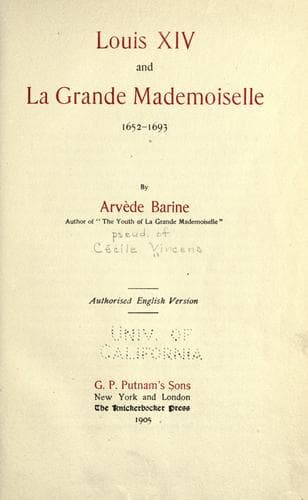
Louis XIV and La Grande Mademoiselle, 1652-1693Barine, Arvède
History
Louis XIV and La Grande Mademoiselle, 1652-1693
Barine, Arvède
Louis XIV, King of France, 1638-1715; Montpensier, Anne-Marie-Louise d'Orléans, duchesse de, 1627-1693
The princes and princesses of the blood considered themselves insulted,
and rebelled, a boldness so unexpected, on account of their habitual
submission, that even Louis XIV. was somewhat moved. The timid
Marie-Therese gave the example. Mademoiselle came to announce formally
the proposed marriage. "I entirely disapprove," said the Queen in a very
sharp tone, "and the King will never sanction it." "He does approve it,
Madame, that is settled." "You would do better never to marry, to keep
your wealth for my son Anjou."[244] Anger gave the Queen courage to
address the King, who was vexed, and the result was a scene, tears, a
night of despair; but also nothing gained, and finally the Queen was
forced into a public declaration that she would sign the contract.
Monsieur loudly protested. He heaped abuses on the "deputies of French
nobility," reproached Mademoiselle in the presence of the King for being
"without heart," and said that she was a person who should be "placed in
an insane asylum,"[245] and also declared that he would _not_ sign the
contract. The gravest accusation made by Monsieur was a statement,
repeated to all, that Mademoiselle had said that the King had himself
counselled the marriage. In vain Mademoiselle asserted that she had said
nothing of the kind; the charge made a great impression upon Louis, and
he expressed his first regret over the affair. The Prince de Conde,
sometimes taunted with having become, somewhat late in life, an
accomplished courtier, remonstrated respectfully but firmly with the
King.
The old Madame, forgotten in her corner of the Luxembourg, never really
felt the wave of disgust and protest, but she was sufficiently aroused
from her apathy to sign a letter to the King, written in her name by M.
Le Pelletier, President of the Department of Inquests. Outside the Court
circle, Louis XIV. felt himself blamed by all classes of society. The
nobles in general refused to ratify the "Mandate" that the deputies had
given in their name. Without doubt, the honour of this marriage would be
great: the permission given to a princess of the blood to marry so far
beneath her rank, a most unexpected favour from a monarch who had worked
so systematically to undermine the power of the aristocracy; but the
larger portion of the French nobility was so much impressed with the
danger of insulting royalty, and weakening the sentiment of the sanctity
of the Heaven-sent rulers, that it joined in the criticism of the rest
of the nation.
Public-domain text, read in full here on John Shaqi.
Reviews
Reviews
No reviews yet
Be the first to share your thoughts on this work.
Elsewhere in the archive
Join the Discussion
Join the discussion
Sign in to leave a comment or review.
Sign InorCreate an account