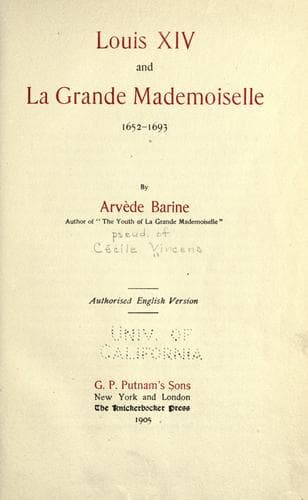
Louis XIV and La Grande Mademoiselle, 1652-1693Barine, Arvède
History
Louis XIV and La Grande Mademoiselle, 1652-1693
Barine, Arvède
Louis XIV, King of France, 1638-1715; Montpensier, Anne-Marie-Louise d'Orléans, duchesse de, 1627-1693
The Parliamentary world and the society of the higher middle class were
equally outraged. It was plain that the marriage could be made only with
the King's consent, and the giving of this was considered a "shame." The
bourgeoisie showed an inconceivable irritation; Segrais heard Guilloire,
Intendant of Mademoiselle, say to his mistress in an excited tone,
knowing very well that he was risking his position, "You are derided and
hated by all Europe." As to the common people, their attitude was
touching. "They were," reports a witness,[246] "in a state of
consternation." They grieved as if their Prince had deceived them.
The enemies of Lauzun increased the discontent and endeavoured to gain
time. Louvois was credited with having persuaded the Archbishop of Paris
to forbid the bans. The minister felt himself directly menaced, and this
was also the opinion of the political world, in which many believed that
the projected marriage was a stroke directed "against M. de Louvois, an
avowed enemy of M. de Lauzun,"[247] by Colbert and Mme. de Montespan.
While the tempest was gathering, the friends of the two lovers pressed
them to hasten the end. "In the name of God," said Rochefort, Captain of
the Guards, "Marry to-day rather than to-morrow!" Montausier "scolded"
them for dallying. Mme. de Sevigne represented to Mademoiselle that they
"were tempting God and the King."[248]
Nothing can be done for people who are walking in the clouds. Lauzun,
"intoxicated with vanity,"[249] believed himself already safe in port,
sheltered from all trouble, with the King and Mme. de Montespan on his
side. Mademoiselle, "dazzled by love," permitted herself to be guided.
Her first desire had been to marry upon the evening of the deputation to
the King, without saying anything about it, but Lauzun refused. "He was
persuaded that Mme. de Montespan would not fail him, and that nothing
could now turn the King against him, and considered everything secure,
saying, "I distrust only you." To marry thus clandestinely would not
satisfy his vanity. He wished that the deed should be done as "from
crown to crown, openly and with all forms observed." He desired the
chapel of the Tuileries, pomp, a crowd, rows of astonished and envious
faces, "rich livery" that he had hastened to order for the occasion. In
short, he longed for the moon and he did not succeed in seizing it.
Tuesday, December 16th, was passed in talking, in expressing
astonishment, in paying compliments. A multitude came to the Luxembourg,
among whom the Archbishop of Reims, brother of Louvois, who said to
Mademoiselle: "Would you do me the injury of choosing any other than
myself to perform the marriage ceremony?" Another had already solicited
the honour, a proof that so far a rupture had not been thought of.
Mademoiselle replied: "M. the Archbishop of Paris has said that he
desired the office."
Public-domain text, read in full here on John Shaqi.
Reviews
Reviews
No reviews yet
Be the first to share your thoughts on this work.
Elsewhere in the archive
Join the Discussion
Join the discussion
Sign in to leave a comment or review.
Sign InorCreate an account