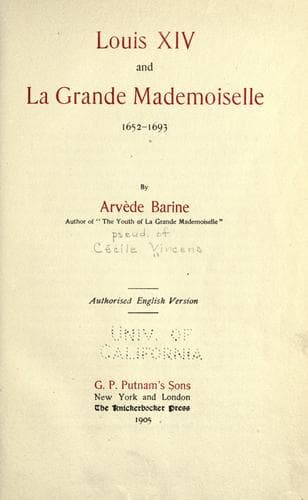
Louis XIV and La Grande Mademoiselle, 1652-1693Barine, Arvède
History
Louis XIV and La Grande Mademoiselle, 1652-1693
Barine, Arvède
Louis XIV, King of France, 1638-1715; Montpensier, Anne-Marie-Louise d'Orléans, duchesse de, 1627-1693
demand if she might not see her friend again. The reply of the King
should be remembered, as it brought serious results for his cousin. He
said: "I do not forbid you to see him; ... and assuredly you cannot take
advice of a worthier man in regard to any of your affairs than Lauzun."
She hastened to confirm the permission. "It is my intention, Sire, and I
am very happy that you desire that he should continue to be my best
friend; but at least, Sire, you will not change as you did before? I
cannot help reproaching you."
The succeeding days she was obliged to reopen her doors, and the same
crowd which had feigned to rejoice with her now pretended to pity her.
It was necessary to see again the same faces, to submit to curious
looks, glances filled with raillery, and to reply to _banal_ remarks.
There was much joking in Paris at her having received condolences in
bed, after the fashion of widows. "I have heard in the salon of Mme. de
Maintenon," relates Mme. de Caylus,[260] "that she cried out in her
despair, 'He should be there beside me!'"
A grand Princess, to be dying of love and for a simple cadet from
Gascogne, almost a country fellow; this was a novel spectacle, which so
shocked all ideas of decorum that the public could not take to heart
very seriously this slightly theatrical grief. It was pretended that
Louis had said, "This is only a fantasy born in three days and which
will pass as rapidly." True or false, the King wished to believe this,
and the phrase received general approbation. It relieved the fashionable
world from the duty of sympathising with the unfortunate, who was eating
out her own heart, and visibly fading away.
"I grew thin, with hollow cheeks, as a person who neither eats nor
sleeps, and I wept the minute that I was alone, or when I met any
friends of M. de Lauzun and they talked of events which had any
connection with him. I always desired to speak of him." The hope of a
speedy death was her sole consolation, for no one, she was convinced had
so deeply suffered. "My state was pitiable, and it must have been
experienced to be appreciated, for such feelings cannot be expressed. It
is necessary to know one's self, in order to judge, and no one can have
felt a grief equal to mine; there is nothing which can compare with it."
This is the universal language of disappointed lovers; but the
expressive phrase below is not at the disposal of all souls. It is only
applicable to moments in which the excess of grief renders it almost
unconscious: "On account of feeling too much, I felt nothing."
The fifth day, etiquette exacted that she should find herself consoled.
Her duties as Princess were recalled to her. "It was needful to go to
Court, it was not well to pass eight days without seeing the King."
Public-domain text, read in full here on John Shaqi.
Reviews
Reviews
No reviews yet
Be the first to share your thoughts on this work.
Elsewhere in the archive
Join the Discussion
Join the discussion
Sign in to leave a comment or review.
Sign InorCreate an account